
 UAE
 Saudi Arabia
 Qatar
 Oman
 Bahrain
 Kuwait
 Lebanon
 Ghana
 UK
 Ireland
 Germany
 France
 Netherlands
 Belgium
 Luxembourg
 USA
 Canada
 Australia
 New Zealand
 Singapore
 Malaysia
 Hong Kong
Foreign remittance withholding tax in Pakistan is the tax a bank deducts when money crosses the border: either leaving your account through a foreign card payment, or arriving as export, freelance or platform income. The Finance Act 2026 changed several of these deductions at once, and many Sialkot exporters, freelancers and online sellers are still working from last year’s rates.
This guide explains each foreign remittance withholding tax deduction in plain language: who pays it, how much it is, and whether it is adjustable, minimum or final. It is written for business owners, not tax specialists.
Key Information at a Glance
| Remittance | Section | Rate (2026) | Collected by | Nature of tax |
|---|---|---|---|---|
| Card payment sent abroad (credit, debit or prepaid) | 236Y | 0.5% of gross amount | Your bank | Adjustable advance tax |
| Export of goods: proceeds received | 154 | 1.25% of proceeds | Bank (authorised dealer) | Minimum tax |
| Export of IT and IT-enabled services by a PSEB-registered exporter | 154A | 0.25% of proceeds (tax years 2024 to 2029) | Bank (authorised dealer) | Final, if conditions are met |
| Other export of services | 154A | 1% of proceeds | Bank (authorised dealer) | Final, if conditions are met |
| Revenue from social media platforms | 154B | 5% | Bank or financial institution | Minimum (resident persons) |
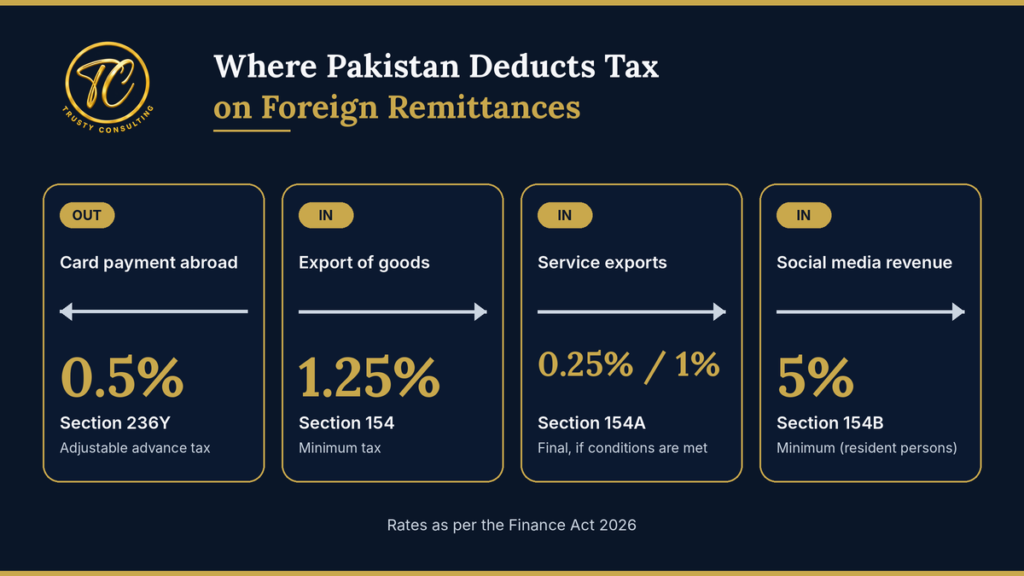
Table of Contents
What Is Foreign Remittance Withholding Tax in Pakistan?
Withholding tax means the tax is taken at source. You do not write a cheque to the FBR. The bank deducts the amount at the moment the foreign exchange moves, and then reports it so that it appears against your NTN.
There is no single “remittance tax” section. Instead, the Income Tax Ordinance, 2001 applies different provisions depending on the direction and purpose of the money:
- Money going out: card payments to foreign merchants fall under section 236Y.
- Money coming in for goods: export proceeds fall under section 154.
- Money coming in for services: software, IT, technical and other service exports fall under section 154A.
- Money coming in from platforms: revenue from social media platforms falls under the new section 154B.
Knowing which section applies to your transaction is the first step, because the rate and the treatment of the tax are different in each case.
Foreign Remittance Withholding Tax on Card Payments Abroad (Section 236Y)
Section 236Y requires a banking company to collect advance tax when it transfers money abroad on behalf of a person who has completed a credit, debit or prepaid card transaction with a party outside Pakistan. The rate is set in Division XXVII of Part IV of the First Schedule.
The Finance Act 2026 reduced this rate from 5% to 0.5% of the gross amount remitted abroad. Subscriptions, software licences, cloud services, overseas advertising spend and international online purchases are typical examples, because the tax follows the card mechanism rather than the type of merchant.
The Ordinance states that tax collected under section 236Y is adjustable. In practice, it can be claimed as advance tax paid when you file your return, so it is not a permanent cost for a taxpayer who files correctly.
| Illustration (hypothetical) | Old rate (5%) | New rate (0.5%) |
|---|---|---|
| Rs. 100,000 card payment abroad | Rs. 5,000 | Rs. 500 |
| Rs. 250,000 of annual foreign subscriptions and ad spend | Rs. 12,500 | Rs. 1,250 |
| Rs. 1,200,000 of annual overseas advertising by an online seller | Rs. 60,000 | Rs. 6,000 |
The statutory text we reviewed gives a single rate of 0.5% and does not create a separate non-filer rate for this section. Even so, always confirm the deduction shown on your bank statement. Filer status still matters for many other transactions, as explained in our guide to what a tax filer in Pakistan is.
Foreign Remittance Withholding Tax on Export Proceeds (Section 154)
When foreign exchange from an export of goods is realised, the authorised dealer deducts tax from the proceeds. The Finance Act 2026 increased the rate under section 154 from 1% to 1.25% of the export proceeds.
Two points matter for exporters. First, this deduction is a minimum tax on the export income, which means your tax for the year cannot fall below it. Second, the additional 1% advance tax that used to be collected on realisation of export proceeds has been omitted, so the overall collection from exporters is lower than before.
For Sialkot’s sports goods, surgical instrument, leather and garment exporters, the practical task is reconciliation: every bank credit advice should match an export invoice, and every deduction should match the tax shown in your return. Our sales tax filing and refund service for Sialkot exporters works on the same documents.
Foreign Remittance Withholding Tax for Freelancers and Service Exporters (Section 154A)
Section 154A applies when an authorised dealer realises foreign exchange for exports of computer software, IT services or IT-enabled services, services rendered outside Pakistan, certain royalties and fees, and construction contracts executed abroad. The rates are:
- 0.25% of proceeds for IT and IT-enabled services where the exporter is registered with and certified by the Pakistan Software Export Board (PSEB), for tax years 2024 up to 2029.
- 1% of proceeds in any other case.
The tax is final only if certain conditions are met: your return has been filed, withholding tax statements have been filed where required, sales tax returns have been filed where required (this condition is relaxed for PSEB-registered IT exporters), and no credit is claimed for foreign taxes paid. A taxpayer who does not meet these conditions, or who opts out of final taxation at the time of filing the return, is taxed under the normal rules instead.
Revenue from Social Media Platforms (Section 154B)
The Finance Act 2026 introduced section 154B. Banks and non-banking financial institutions must deduct 5% when an amount credited to your account represents revenue from social media platforms such as YouTube, Facebook, Instagram or TikTok.
The law defines “payment” widely. It includes any inward remittance, transfer or credit received through banking channels, including through online payment providers or digital financial platforms. For a resident creator the deduction is a minimum tax; for a non-resident without a permanent establishment in Pakistan it is final.
What This Tax Is Not: The Rs. 5 Million Rule in Section 111(4)
Receiving money from abroad is a separate question from tax being deducted on it. Section 111(4) stops the FBR from treating foreign exchange as unexplained income if it is remitted through normal banking channels, does not exceed Rs. 5 million in a tax year, and is encashed into rupees by a scheduled bank with a certificate from that bank.
Remittances through exchange companies, money service bureaus and money transfer operators are treated as normal banking channels. This is a source-of-funds protection, not a foreign remittance withholding tax rule. Our detailed guide to foreign remittance tax and section 111(4) covers it in full.
Two Hypothetical Examples from Sialkot
These examples are illustrations only. They do not describe real clients.
Hassan and the Overlooked Credit
Hassan runs an online sports goods brand from Sialkot and pays for social media advertising with a business debit card. Over a year he spends Rs. 1,200,000 abroad. His bank deducts 0.5%, which is Rs. 6,000, on every payment. He treated it as a bank charge and never claimed it. A Sialkot tax consultant would show him that section 236Y tax is adjustable and belongs in the advance tax section of his return.
Ayesha and the Registration Gap
Ayesha is a freelance web developer working from Sialkot for clients in Europe. She receives Rs. 4,000,000 in a year through her bank, and 1% (Rs. 40,000) is deducted under section 154A because she is not PSEB-registered. A PSEB-certified exporter would have paid 0.25%, which is Rs. 10,000, on the same amount. Her adviser checks whether she is eligible for registration and whether her return, withholding statements and other conditions are in order, so the deduction can be treated as final.
Step-by-Step: How to Handle Foreign Remittance Withholding Tax Correctly
- Classify the remittance. Decide whether foreign remittance withholding tax applies as a card payment abroad, export of goods, export of services or platform revenue.
- Check your registrations. Confirm that your NTN is active and, for IT exporters, that PSEB certification is current.
- Collect bank evidence. Keep credit advices, deduction advices, statements and any withholding tax certificate your bank can provide.
- Match each deduction to a document. Link every credit to an invoice, contract or export document.
- Test the conditions for final tax. For section 154A, confirm that your return, withholding statements and sales tax returns are filed where required.
- Report correctly on IRIS. Claim section 236Y tax as advance tax, and show section 154, 154A and 154B income under the correct treatment.
- Reconcile with your wealth statement. Make sure bank credits, tax deducted and declared assets agree, as explained in our wealth statement guide under Section 116.
Common Mistakes to Avoid
- Treating section 236Y as a lost cost. It is adjustable and should be claimed.
- Assuming every freelancer pays 0.25%. The lower rate depends on PSEB registration and certification.
- Assuming section 154A is automatically final. The conditions must be met each year.
- Using unofficial channels. Money received outside normal banking channels loses the section 111(4) protection.
- Ignoring the new creator rule. Platform revenue is now caught by section 154B.
- Not reconciling foreign remittance withholding tax. Differences between bank records and the return invite notices.
How Trusty Consulting Can Help
Foreign remittance withholding tax touches your return, your books and your bank records at the same time. As a Sialkot tax consultant serving exporters, freelancers and online businesses across Pakistan, Trusty Consulting can support you with:
- Income tax return preparation and filing, including correct treatment of tax deducted at source.
- Reconciliation of remittances, export documents and foreign remittance withholding tax deductions.
- Accounts for tax purposes that support your income computation.
- Sales tax filing and refund assistance for exporters.
Frequently Asked Questions
What is foreign remittance withholding tax in Pakistan?
Foreign remittance withholding tax is tax deducted by a bank at source when foreign exchange leaves or enters Pakistan for specified purposes: card payments abroad, export proceeds, service exports and social media revenue. It is not a single tax, because each section has its own rate and treatment.
What is the tax on foreign card payments in Pakistan in 2026?
Under section 236Y, your bank collects advance tax at 0.5% of the gross amount remitted abroad on credit, debit or prepaid card transactions with foreign parties. The Finance Act 2026 reduced it from 5%.
Is the section 236Y tax refundable?
It is adjustable, meaning you can claim it as advance tax against your annual liability. Whether any excess is refundable depends on your overall return position, so review it with your adviser.
Do filers and non-filers pay different rates under section 236Y?
The statutory text we reviewed specifies a single rate of 0.5% and no separate non-filer rate. Check the deduction on your bank statement, and file your return on time to avoid higher rates elsewhere.
What is the tax rate for freelancers receiving foreign payments?
Under section 154A the rate is 0.25% for PSEB-registered and certified IT and IT-enabled service exporters (tax years 2024 to 2029), and 1% in other cases.
Is tax deducted on export proceeds final?
For exports of goods under section 154, the 1.25% deduction is a minimum tax, not a final tax. It sets a floor for your tax on that income.
Is tax deducted on money my relatives send from abroad?
These withholding sections apply to specific categories: card payments abroad, export proceeds, service exports and platform revenue. An ordinary family remittance is not one of them. What matters there is the section 111(4) protection for amounts up to Rs. 5 million per tax year through normal banking channels.
Has the Rs. 5 million limit in section 111(4) changed?
In the version of the Ordinance we reviewed, the limit remains Rs. 5 million per tax year. Relaxation proposals were reported before the budget, so check the current text before relying on any higher figure.
Can Trusty Consulting help Sialkot exporters with remittance tax reconciliation?
Yes. We prepare returns, accounts and reconciliations for exporters, freelancers and online businesses. You can reach us on WhatsApp or through our contact page.
Conclusion
Foreign remittance withholding tax in Pakistan is not one rule but four: 0.5% on foreign card payments, 1.25% on export proceeds, 0.25% or 1% on service exports, and 5% on social media revenue. The treatment of each (adjustable, minimum or final) decides whether the deduction is a credit or a cost.
Before you file, classify every remittance, keep bank evidence, test the conditions for final tax, and reconcile everything with your books. If you would like a professional review, speak with our team.
Disclaimer: This article is for general information and reflects the Income Tax Ordinance, 2001 as amended by the Finance Act 2026. It is not legal or tax advice. Tax treatment depends on individual facts, so obtain professional advice before acting.