
 UAE
 Saudi Arabia
 Qatar
 Oman
 Bahrain
 Kuwait
 Lebanon
 Ghana
 UK
 Ireland
 Germany
 France
 Netherlands
 Belgium
 Luxembourg
 USA
 Canada
 Australia
 New Zealand
 Singapore
 Malaysia
 Hong Kong
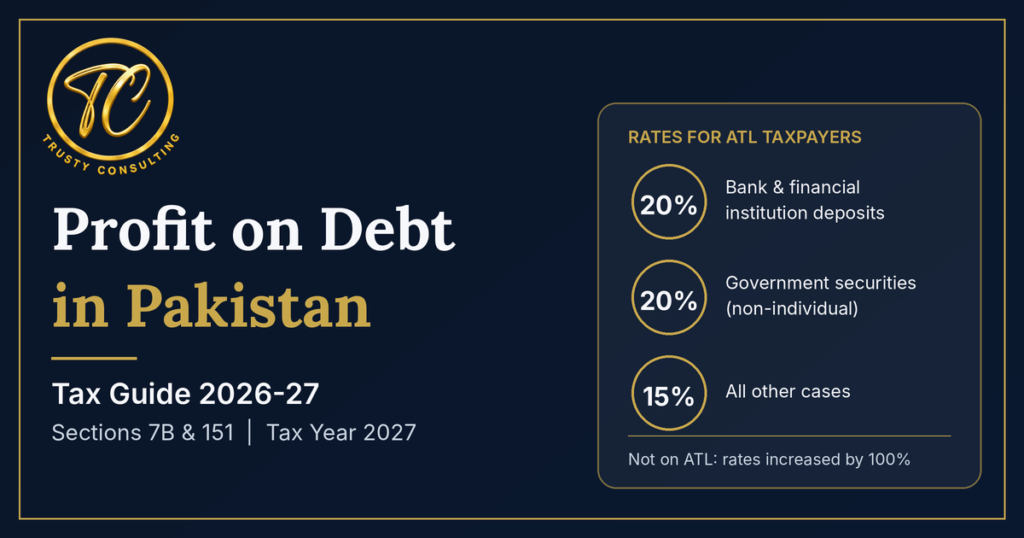
Profit on debt in Pakistan is the yield or profit you earn on bank deposits, National Savings certificates, government securities, bonds and similar instruments. For tax year 2027 (1 July 2026 to 30 June 2027), the tax on profit on debt in Pakistan is 20% on bank and financial institution deposits, 20% on government securities paid to anyone other than an individual, and 15% in all other cases, with the rates doubled for anyone not on the Active Taxpayers’ List.
If you are a business owner, exporter or investor in Sialkot, the difficult part is not the rate. It is knowing when the tax your bank deducts is the end of the matter and when it is only the beginning. This guide explains profit on debt in Pakistan under sections 7B and 151 of the Income Tax Ordinance, 2001, as amended by the Finance Act, 2026.
Key Information at a Glance
| Point | Current position (tax year 2027) |
|---|---|
| Governing sections | Section 7B (charge of tax) and section 151 (deduction at source), read with Division IIIA of Part I and Division IA of Part III of the First Schedule |
| Bank and financial institution deposits | 20% for taxpayers on the Active Taxpayers’ List (ATL) |
| Government securities | 20% if paid to a person other than an individual; 15% otherwise |
| Other cases (for example National Savings certificates) | 15% |
| Taxpayers not on the ATL | Deduction rates are increased by 100% under the Tenth Schedule (40%, 40% and 30%) |
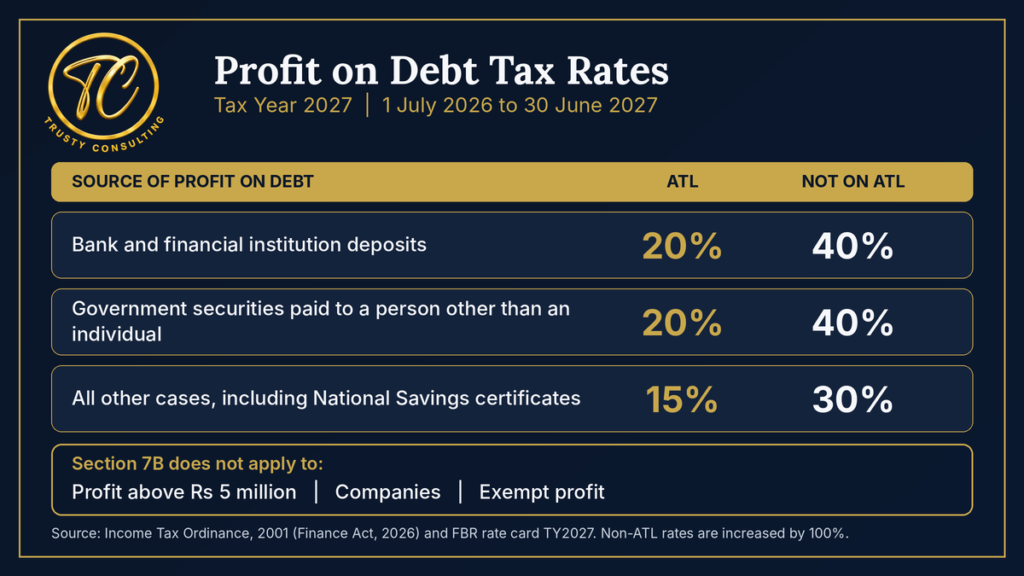
| Rs 5 million limit | Section 7B does not apply to profit on debt exceeding Rs 5 million |
| Companies | Section 7B does not apply; tax deducted is adjustable |
Table of Contents
What Is Profit on Debt in Pakistan?
The Income Tax Ordinance uses the term “profit on debt” for the return you earn when you lend or deposit money. For individuals and businesses in Sialkot, the usual sources are:
- Profit on savings accounts, term deposits and certificates held with a bank or financial institution
- Yield on National Savings Scheme certificates
- Profit on government securities such as Treasury bills and Pakistan Investment Bonds
- Profit on other bonds, certificates, debentures and securities paid by the government, banks or companies
- Return on sukuk, which has its own rate table
Section 7B imposes tax on every person other than a company who receives profit on debt from a payer covered by section 151(1). The tax is calculated on the gross amount of the profit, so no expenses are deducted from it.
Profit on Debt Tax Rates in Pakistan for Tax Year 2027
The rates below follow Division IA of Part III of the First Schedule, as amended by the Finance Act, 2026, and match the FBR withholding tax rate card for tax year 2027. Rates are checked as at 27 November 2026.
| Source of profit on debt | ATL (filer) | Not on ATL |
|---|---|---|
| Yield or profit on an account or deposit with a banking company or financial institution | 20% | 40% |
| Government securities paid to a person other than an individual | 20% | 40% |
| All other cases, including individuals holding government securities and National Savings certificates | 15% | 30% |
| Sukuk return, company holder (section 151(1A)) | 25% | 50% |
| Sukuk return, individual or AOP, above Rs 1 million | 12.5% | 25% |
| Sukuk return, individual or AOP, below Rs 1 million | 10% | 20% |
The bank rate was 15% until the Finance Act, 2025 raised it to 20%, so any calculation still using 15% on bank profit is out of date. For the wider picture, see our income tax rate card for 2026-27 page.
Section 7B and Section 151: Is Tax on Profit on Debt in Pakistan Final?
Many readers confuse the two sections that govern profit on debt in Pakistan. Section 151 tells the bank or other payer to deduct tax when it pays the profit. Section 7B decides what kind of tax that is for you.
- Individuals and AOPs with profit up to Rs 5 million: tax under section 7B is a separate charge on the gross profit, and the amount deducted at source settles it as final tax.
- Profit above Rs 5 million: section 7B does not apply. The profit is taxed with your other income, and section 151 deduction is a minimum tax.
- Companies: section 7B applies only to persons other than companies, so the deduction is adjustable against the company’s tax liability.
- Exempt profit: section 7B does not apply to profit on debt that is exempt under the Ordinance.
This is the same logic behind the final tax regime and normal tax regime distinction, which affects how income is reported and how refunds are treated.
The Rs 5 Million Limit on Profit on Debt in Pakistan
The limit on profit on debt in Pakistan is easy to misread. Section 7B(3)(b) says the section does not apply to profit on debt that exceeds five million rupees. Once your profit passes that figure, the whole amount moves out of the separate final tax block and into your normal tax computation. Because the section 151 deduction is then only a minimum tax, you may owe more at assessment if your slab rate on total income is higher than the rate deducted.
Not on the Active Taxpayers’ List: What Changes
For profit on debt in Pakistan, rule 1 of the Tenth Schedule increases the rate of deduction by 100% for persons not appearing on the ATL. For a bank depositor, that means 40% is deducted instead of 20%. Where the deduction is a final tax, section 169(4) provides that the final tax is the First Schedule rate, and the excess is adjustable if you file your return before assessment is finalised, as provided in rule 4 of the Tenth Schedule.
In practice, the excess is blocked until the return is filed and processed. Checking your ATL status before profit is credited is cheaper than recovering over-deducted tax afterwards.
Zakat and Profit on Debt
Section 151 requires the payer to deduct tax on the gross profit after reducing it by Zakat, if any, paid by the recipient under the Zakat and Ushr Ordinance, 1980. Where profit on debt is chargeable under the head “Income from Other Sources”, section 40(2) also allows a deduction for Zakat paid at the time the profit is paid. Keep your Zakat deduction record with your bank certificates.
Practical Examples from Sialkot (Hypothetical)
The two examples below are illustrations only. The names and figures are invented and do not describe real clients.
Example 1: Haji Rashid, ATL taxpayer
Under the rules on profit on debt in Pakistan, Haji Rashid, a retired sports goods trader in Sialkot, earns Rs 2,000,000 as profit on his term deposits during the tax year. He is on the ATL. The bank deducts 20%, which is Rs 400,000. Because his profit is below Rs 5 million and he is not a company, this is his final tax on that income under section 7B.
Example 2: Ayesha Malik, not on the ATL
For profit on debt in Pakistan, Ayesha Malik, a surgical instruments exporter, earns Rs 1,500,000 on a bank deposit but is not on the ATL. The bank deducts 40%, which is Rs 600,000. The First Schedule rate is 20%, or Rs 300,000. The extra Rs 300,000 is not lost, but she can only seek adjustment by filing her return in time under rule 4 of the Tenth Schedule.
Other Income From Savings and Debt Instruments
Not every gain on a debt instrument is profit on debt. Selling a debt security before maturity produces a capital gain, and section 151A requires the custodian or bank to deduct tax at 20% of the gross capital gain under Division IIIAA. Keep the periodic profit and the sale gain separate when you report.
How to Report Profit on Debt in Pakistan in Your Return
- Collect the tax deduction certificates or annual statements from every bank, National Savings centre and securities custodian.
- Check that your name appears on the ATL for the relevant tax year.
- Classify each amount: bank deposit, government security, National Savings certificate, sukuk or sale gain.
- Confirm whether the profit stays within the Rs 5 million limit and whether section 7B applies to you.
- Compare the tax deducted with the correct rate, and note any excess caused by non-ATL status.
- Reconcile the profit credited with your bank balance and your wealth statement before filing.
This is the work we handle for clients through our income tax return filing in Sialkot service, including profit on debt in Pakistan reported by exporters and individuals.
7 Essential Tax Mistakes on Profit on Debt in Pakistan
- Using the old 15% bank rate. The Finance Act, 2025 raised it to 20%.
- Ignoring ATL status. Non-ATL taxpayers face rates doubled at the time of payment.
- Assuming the deduction is always final. It is not for companies, and not for profit above Rs 5 million.
- Mixing sale gains with periodic profit. Section 151A applies to gains on disposal of debt securities.
- Losing bank certificates. Without them, a refund or adjustment claim is hard to support.
- Skipping reconciliation. Profit credited should agree with your accounts and wealth statement.
- Overlooking special schemes and exemptions. Items such as Bahbood Savings Certificates and Pensioner’s Benefit Accounts follow separate Second Schedule treatment, so check before applying the standard rates.
How Trusty Consulting Can Help
As a Sialkot tax consultant, Trusty Consulting helps individuals, exporters and companies review profit on debt in Pakistan before filing. Our team can:
- Check ATL status and the tax deducted against the current rates
- Classify income correctly between section 7B, normal income and capital gains
- Prepare accounts for tax purposes and the supporting schedules
- Provide accounting and bookkeeping support so bank profit is reconciled throughout the year
- Advise on how profit on debt fits into your overall tax position
We do not promise particular tax outcomes. We work from your documents and the law as it stands on the date of advice.
Frequently Asked Questions
What is the tax rate on profit on debt in Pakistan for 2026-27?
For tax year 2027, the rate is 20% on bank and financial institution deposits, 20% on government securities paid to a person other than an individual, and 15% in other cases, for taxpayers on the ATL. Non-ATL taxpayers face rates increased by 100%.
Is tax on profit on debt in Pakistan final for bank deposits?
For individuals and AOPs whose profit on debt does not exceed Rs 5 million, tax under section 7B is a final tax. For companies and for profit above Rs 5 million, the deduction is not final.
What happens if my profit on debt in Pakistan exceeds Rs 5 million?
Section 7B no longer applies. The profit is taxed with your other income, and the section 151 deduction operates as a minimum tax.
Is profit on debt in Pakistan taxed more heavily if I am not on the Active Taxpayers’ List?
Yes. The rate of deduction is increased by 100% under the Tenth Schedule. The excess may be adjustable if you file your return as required before assessment is finalised.
Does section 7B apply to companies?
No. Section 7B applies to persons other than companies. For a company, tax deducted under section 151 is adjustable against its tax liability.
Is profit on National Savings certificates taxed at 20%?
Not under the general rate table. Yield on National Savings certificates falls under the 15% category for ATL taxpayers, subject to any special scheme treatment.
Are gains on selling government securities treated as profit on debt?
No. A gain on disposal of a debt security is a capital gain. Section 151A requires 20% to be deducted on the gross gain under Division IIIAA.
Can Zakat be deducted from profit on debt?
Yes. Section 151 reduces the gross profit by Zakat paid by the recipient before tax is deducted, and section 40(2) allows a Zakat deduction where the profit is taxed under Income from Other Sources.
Conclusion
Profit on debt in Pakistan looks simple until ATL status, the Rs 5 million limit and the difference between individuals and companies are applied. Check the rate that applies to each source, keep your bank certificates, and reconcile the profit with your accounts before you file.
For a review of your own position, speak to a Sialkot tax consultant who works from the current text of the Ordinance and the Federal Board of Revenue (FBR) notifications.
You can also book a consultation through tconsultingpk.com or message us on WhatsApp at +92 329 6325872.
Disclaimer: this article is general information on Pakistani tax law as at 27 November 2026. It is not personalised tax advice. Rates and rules can change through Finance Acts and FBR notifications, so confirm your position with a qualified professional before acting.