
 UAE
 Saudi Arabia
 Qatar
 Oman
 Bahrain
 Kuwait
 Lebanon
 Ghana
 UK
 Ireland
 Germany
 France
 Netherlands
 Belgium
 Luxembourg
 USA
 Canada
 Australia
 New Zealand
 Singapore
 Malaysia
 Hong Kong
If you are a sole founder who wants limited liability without finding a partner, single member company registration with the Securities and Exchange Commission of Pakistan (SECP) is the route to understand first. One person can own the company, act as its director and keep the legal separation between personal and business assets.
This guide explains what a single member company (SMC) is, how its name works, which documents and nominee details you need, and what to do after incorporation. It is written for freelancers, consultants, traders and small exporters, including those in Sialkot who have outgrown a sole proprietorship.
Table of Contents
Single Member Company Registration at a Glance
| Item | What to know |
|---|---|
| Regulator | Securities and Exchange Commission of Pakistan (SECP), under the Companies Act, 2017 |
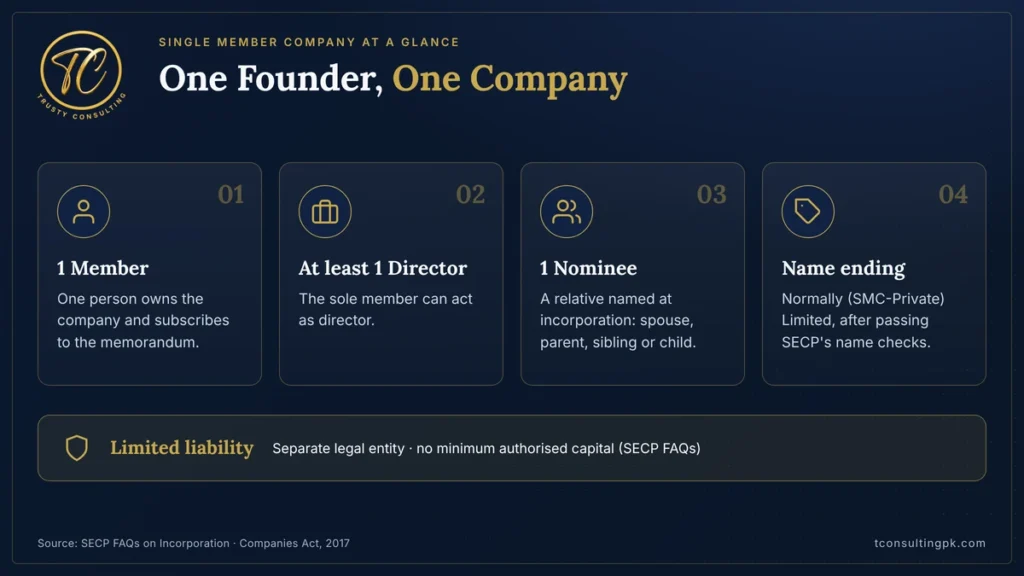
| Members required | One person only |
| Directors required | At least one; the sole member can act as director |
| Company name ending | Typically (SMC-Private) Limited |
| Nominee | A relative of the member, named at incorporation |
| Minimum authorised capital | SECP states there is no minimum requirement |
| Filing route | SECP eZfile online process using the Companies Regulations, 2024 formats |
| Tax number | SECP data is integrated with FBR for NTN issuance, subject to complete and accurate information |
What Is a Single Member Company (SMC)?
SECP describes a company formed by one person as a single member company. It is a private company with one member, so it has its own legal identity and limited liability, but without the need for a second shareholder.
Before the Companies Act, 2017 introduced this structure for ordinary use, a sole founder usually had two poor choices: operate as a sole proprietorship with unlimited personal liability, or add a nominal second shareholder to form a private limited company. Single member company registration removes that workaround.
SECP’s press release of 5 November 2026 shows how popular the structure has become. Single member companies made up 2,079 registrations, or 41.6%, of the new incorporations reported in that release, while Punjab accounted for 53.2% of all registrations.
Who Should Choose Single Member Company Registration?
Single member company registration suits owners who want to keep full control but need a credible, limited-liability entity. Typical candidates include:
- Freelancers and IT professionals who sign contracts with local or foreign clients
- Consultants, designers and agents who want a company bank account and company-level invoicing
- Small traders and manufacturers in Sialkot who are outgrowing a sole proprietorship
- Export-oriented founders who want a formal entity before approaching buyers or banks
- Owners who want the business to survive them through a nominated successor arrangement
Hypothetical example: Imran, a Sialkot-based sports goods sourcing agent, works alone and deals with overseas buyers. His buyers ask for a registered company, and he does not want his house or savings exposed to business disputes. Because he has no partner, an SMC fits better than a private limited company. This example is illustrative only and is not a real client case. If you are planning exports as well, see our notes on starting an export business in Sialkot.
SMC vs Sole Proprietorship vs Private Limited Company
Choosing the structure is the first decision. The comparison below summarises the practical differences for small business owners.
| Factor | Sole proprietorship | Single member company | Private limited company |
|---|---|---|---|
| Owners | One | One member | Two or more members |
| Separate legal entity | No | Yes | Yes |
| Owner liability | Unlimited personal liability | Limited to shares held | Limited to shares held |
| Regulator | FBR for tax; local registrations as applicable | SECP and FBR | SECP and FBR |
| Name ending | None | (SMC-Private) Limited | (Private) Limited |
| Best for | Very small, low-risk activity | Sole founders wanting limited liability | Co-founders, investors, growth plans |
If you are still deciding, read our pages on sole proprietorship registration and private limited company registration. For a broader overview of local options, see our company registration in Sialkot guide.
Choosing Your Company Name for Single Member Company Registration
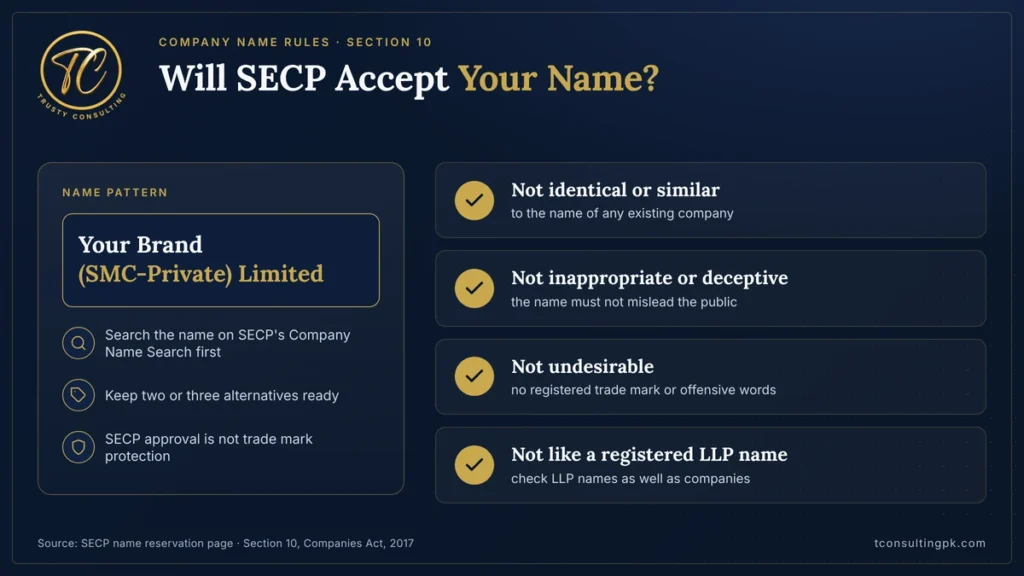
You are free to propose the name you prefer, but it must pass SECP’s checks. SECP states that a proposed name must comply with Section 10 of the Companies Act, 2017 before you apply.
What SECP checks
- The name must not be identical to, resemble or be similar to an existing company name
- It must not be inappropriate or deceptive
- It must not be undesirable, for example by including a registered trade mark or words that offend any section of the people
- It must not be identical or similar to the name of a registered LLP
The SMC name ending
A single member company normally carries the words (SMC-Private) Limited after its name. A private limited company carries (Private) Limited instead. Use SECP’s Company Name Search tool, listed on its registration page, before you finalise your preferred option, and keep two or three alternatives ready.
Two practical cautions apply. First, SECP name approval is not trade mark protection, so check intellectual property separately if the brand matters. Second, fees for name availability or reservation are additional to the incorporation fee, as SECP’s fee calculator itself notes.
[INSERT IMAGE 2 HERE — SECP COMPANY NAME RULES CHECKLIST]
Requirements for Single Member Company Registration
Member and director
Only one person subscribes to the memorandum as the sole member. SECP’s promoters’ guide states that an SMC needs a minimum of one director, and the sole member can act in that role.
Nominee
Every SMC must name a nominee at incorporation. SECP’s FAQs say the nominee must be a relative of the single member: spouse, father, mother, brother, sister, son or daughter. Under SECP’s promoters’ guide, the nominee transfers the shares to the legal heirs if the member dies and manages the company as a trustee until that transfer is complete.
If the shares pass to more than one legal heir, the company ceases to be a single member company and must comply with Section 47 of the Companies Act, 2017. Plan for this in advance if you have several heirs.
Capital and registered office
SECP states there is no minimum requirement for authorised capital. Your fee, however, depends on the authorised capital you choose. A company must also provide its registered office address within 30 days of incorporation.
Documents to keep ready
- CNIC of the sole member (passport for a foreign national)
- CNIC or NICOP copy of the nominee, with relationship and contact details
- Proposed company name, with alternatives
- Principal line of business and registered office address
- Proposed authorised capital and shareholding
- Active mobile number and email for the eZfile account
The exact checklist can change with SECP’s current forms, so confirm it on the SECP registration page before filing.
Step-by-Step Single Member Company Registration Process
SECP describes company incorporation as a digitised process. The sequence below turns that into a practical working order for an SMC.
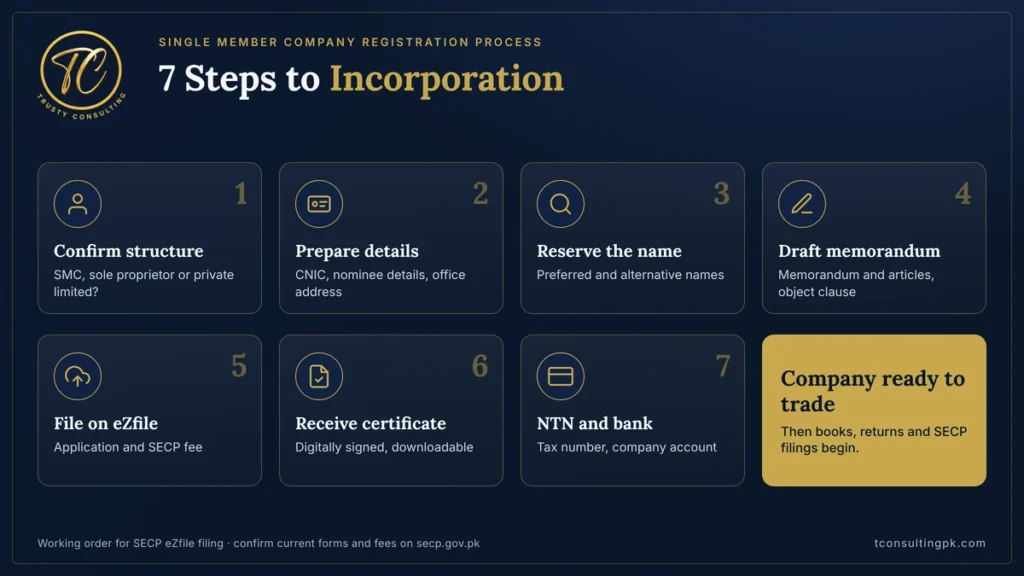
- Confirm the structure. Check that a single member company suits your business, tax position and succession plans.
- Prepare personal details. Collect your CNIC, the nominee’s details and your registered office address.
- Search and reserve the name. Run the SECP name search, then apply for availability or reservation with your preferred and alternative names.
- Prepare the memorandum and articles. SECP’s guide notes that these are generated online for electronic filing. Review the object clause so it covers your intended activities.
- File through eZfile. Submit the incorporation application with the required details and pay the fee shown by SECP’s calculator.
- Receive the certificate. SECP issues a digitally signed certificate of incorporation, emailed to the company and downloadable from eZfile after login.
- Complete tax and bank steps. Confirm your NTN, then open the company bank account and register for other taxes if applicable.
SECP Fees for Single Member Company Registration
SECP calculates the incorporation fee from authorised capital under the Seventh Schedule of the Companies Act, 2017. Fee amounts have been revised more than once, so do not rely on figures copied from older blogs or social media posts.
Use SECP’s Company Incorporation Fee Calculator for the current amount, and add the name availability fee separately. If you appoint Trusty Consulting, we will confirm the SECP fee before filing so that there are no surprises.
What to Do After Single Member Company Registration
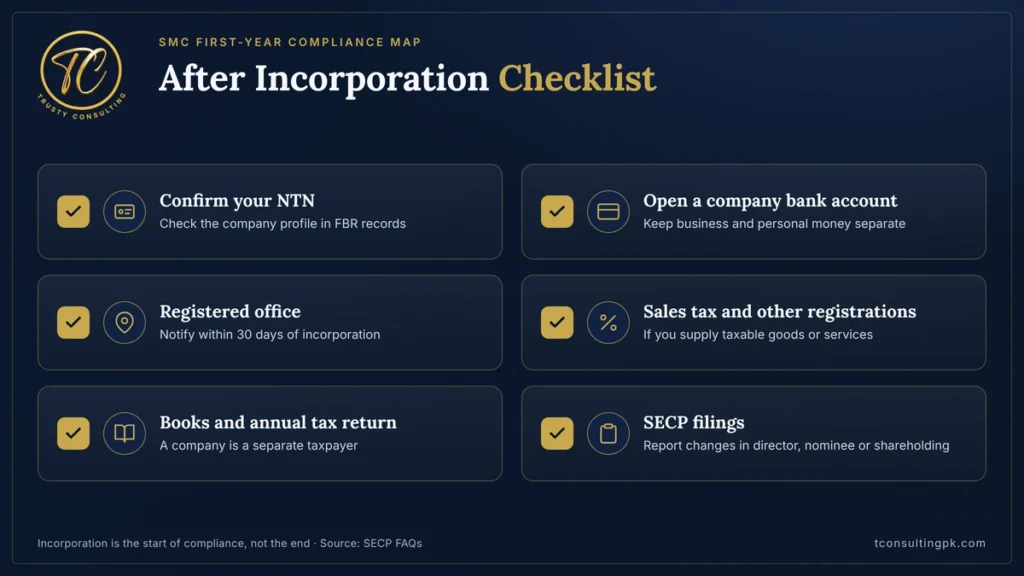
Incorporation is the beginning of compliance, not the end. A newly formed SMC should work through the following list.
- NTN: SECP says its data is integrated with FBR for NTN registration, and an NTN is issued where complete and accurate information is provided. Verify that your company profile shows correctly in FBR records.
- Bank account: Open a business account in the company name and keep personal and business money separate.
- Registered office: Notify the registered office address within 30 days of incorporation.
- Sales tax and other registrations: Register if you supply taxable goods or services, or if your activity needs a licence.
- Books and tax returns: A company is a separate taxpayer, so maintain proper accounts and file the annual income tax return.
- SECP filings: Track changes in directors, nominee, shareholding or registered office, and file the annual return where required.
Our team can support the recurring work through accounting and bookkeeping, income tax filing and SECP annual return filing.
Governance relaxations for SMCs
The Companies Act, 2017 reduced several governance requirements for single member companies. According to SECP’s 2017 summary of the new law, SMCs were exempted from appointing a company secretary and from holding general and board meetings. SECP’s promoters’ guide also says an annual return is not required from an SMC unless there is a change in membership or directorship.
Rules and forms are updated from time to time, and older guides do not always agree with each other. Confirm the current position before relying on any exemption, particularly for financial statements and tax filings, which remain necessary.
Common Mistakes in Single Member Company Registration
- Choosing a name too late. A rejected name delays the whole application. Search three options before you start.
- Naming an ineligible nominee. The nominee must be a relative within the list SECP gives.
- Ignoring succession. Several legal heirs can end SMC status under Section 47, so plan ownership transfer early.
- Writing a narrow object clause. If your activities expand, you may need to amend the memorandum later.
- Relying on outdated fees or forms. Always use SECP’s current calculator and formats.
- Mixing personal and company money. This weakens the practical value of limited liability and creates tax problems.
- Forgetting post-incorporation filings. Late filings can lead to penalties and avoidable notices.
How Trusty Consulting Can Support Your SMC Registration
Trusty Consulting works from Sialkot and supports business owners with company registration service in Sialkot, SECP compliance support and ongoing accounting. For a single member company, we can help you with:
- Choosing between an SMC, sole proprietorship and private limited company
- Name checks and preparation of alternative names
- Preparing the memorandum, articles and nominee details for SECP filing
- Coordinating the eZfile application and following up on the certificate of incorporation
- NTN confirmation, tax registrations and first-year compliance planning
- Setting up bookkeeping so the company is ready for returns, banks and buyers
We explain the options first and then act on the structure you choose. We do not promise approval, because SECP and FBR decide each application on its own facts.
Frequently Asked Questions About Single Member Company Registration
What is single member company registration?
Single member company registration is the SECP process of incorporating a private company with only one member. The company becomes a separate legal person with limited liability, while the founder keeps full ownership.
Who can form a single member company in Pakistan?
One person can form an SMC by complying with the requirements for registering a private company. You should confirm your own eligibility and any activity-specific licences with SECP or a professional adviser.
How many directors does an SMC need?
SECP’s promoters’ guide states a minimum of one director for a single member company. The sole member can act as that director.
Who can be the nominee in an SMC?
According to SECP’s FAQs, the nominee must be a relative of the single member: spouse, father, mother, brother, sister, son or daughter.
Is there a minimum capital for an SMC?
SECP’s FAQs state that there is no minimum requirement for authorised capital. The incorporation fee, however, depends on the authorised capital you choose.
What should my SMC name end with?
A single member company normally uses the ending (SMC-Private) Limited, while a private limited company uses (Private) Limited. The core name must still pass SECP’s Section 10 checks.
Can an SMC become a private limited company later?
If the shares pass to more than one legal heir, SECP’s guide says the company ceases to be an SMC and must comply with Section 47. Conversions for other reasons should be reviewed against the current Companies Act and regulations.
Do I need an NTN after registration?
Yes, a company needs tax registration. SECP states that its data is integrated with FBR for NTN registration, and an NTN is issued when complete and accurate information is provided.
How long does single member company registration take?
Timing depends on name approval, document quality and SECP processing. We do not promise a fixed timeline, but complete documents and a cleared name usually avoid avoidable delays.
Conclusion: Is Single Member Company Registration Right for You?
Single member company registration gives a sole founder limited liability, a professional identity and a clear succession mechanism through the nominee. It works best when you are confident about the name, the nominee and the compliance routine that follows incorporation.
Before you file, confirm your structure, check the name, prepare the nominee details and use SECP’s current fee calculator. After incorporation, set up accounts and tax compliance immediately so the company starts on a clean footing.
You can also reach us through our contact page or on WhatsApp at +92 329 6325872.
Disclaimer
This article is for general information only and is not legal, tax or investment advice. Company law, SECP fees, forms and procedures change from time to time. Please confirm the current position with SECP or a qualified professional before acting.