
 UAE
 Saudi Arabia
 Qatar
 Oman
 Bahrain
 Kuwait
 Lebanon
 Ghana
 UK
 Ireland
 Germany
 France
 Netherlands
 Belgium
 Luxembourg
 USA
 Canada
 Australia
 New Zealand
 Singapore
 Malaysia
 Hong Kong
A foreign income and assets statement is a separate disclosure that certain Pakistani resident individuals must submit with their income tax return when their overseas income or overseas assets cross the limits set in Section 116A of the Income Tax Ordinance, 2001. If you earn from abroad, hold a foreign bank account or own property outside Pakistan, you need to know whether this applies to you before the return deadline.
This guide explains who must file, what the foreign income and assets statement must contain, how it differs from the wealth statement, the penalty for default and the mistakes that cause problems. It reflects the Ordinance as updated to 30 June 2026 and was last reviewed on 27 November 2026.
Key Information at a Glance
| Point | Position under Section 116A |
|---|---|
| Who must file | Every resident taxpayer who is an individual and meets either threshold |
| Income threshold | Foreign income of not less than US$10,000 |
| Asset threshold | Foreign assets valued at not less than US$100,000 |
| Filed with | The annual income tax return, on the prescribed form (Rule 36A, Income Tax Rules, 2002) |
| Position date for assets and liabilities | The last day of the tax year (30 June) |
| Penalty for default | 2% of the foreign income or value of the foreign assets for each year of default (Section 182(1), serial 1AAA) |
| Commissioner’s power | Written notice requiring a statement from an individual who should have filed (Section 116A(2)) |
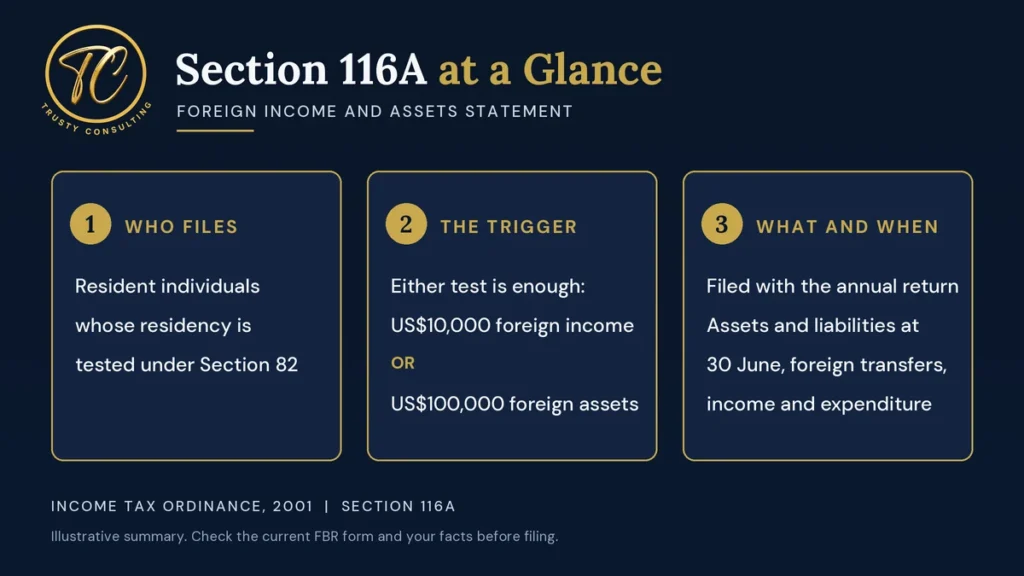
Table of Contents
What Is a Foreign Income and Assets Statement?
Section 116A was inserted into the Income Tax Ordinance, 2001 by the Finance Act, 2018. It requires a resident individual who meets the thresholds to give the tax authorities a statement of foreign assets, liabilities, transfers, income and related expenditure. The official wording is available at Section 116A on the FBR website.
The foreign income and assets statement is a disclosure, not a tax calculation. Filing it does not by itself create a tax liability. Whether foreign income is taxed in Pakistan depends on other provisions, which this article summarises later.
Who Must File the Foreign Income and Assets Statement?
The obligation falls on a resident taxpayer who is an individual. Two conditions matter: residency and the thresholds.
Residency
Under Section 82, an individual is resident for a tax year if present in Pakistan for 183 days or more in that year. The section also covers federal or provincial government employees posted abroad, and a Pakistani citizen who is not present in any other country for more than 182 days or is not a resident taxpayer of another country. If your residency is unclear, settle it first, because the rest of the analysis depends on it.
The two thresholds
You must file the foreign income and assets statement if you meet either of these tests:
- Foreign income of not less than US$10,000; or
- Foreign assets with a value of not less than US$100,000.
Meeting one test is enough to trigger the foreign income and assets statement. A person with US$30,000 of foreign income and no foreign assets must file, and so must a person with a US$120,000 overseas property and no foreign income. Section 116A states the limits in US dollars. The section text does not fix a conversion rate, so choose a documented rate and apply it consistently, and confirm the approach with your adviser.
Section 114(1)(b)(x) also makes a resident individual who is required to file this statement liable to furnish a return of income. In other words, the foreign income and assets statement brings you into the return-filing net even if you would otherwise have been outside it. Individuals who are not resident in Pakistan for the year are outside Section 116A as written.
What the Statement Must Contain
Section 116A(1) requires particulars of the following, in the prescribed form and verified in the prescribed manner:
- Total foreign assets and liabilities as on the last day of the tax year;
- Any foreign assets transferred to another person during the tax year, and the consideration received;
- Complete particulars of foreign income, the expenditure incurred during the tax year, and the expenditure wholly and necessarily incurred for deriving that income.
FBR prescribes the form under Rule 36A of the Income Tax Rules, 2002, with the format in Part IVA of the Second Schedule to the Rules. For Tax Year 2025, FBR also notified an electronic foreign income and assets declaration for resident individuals through SRO 1562(I)/2025. Form layouts change from year to year, so use the version available on IRIS for your tax year.
Documents to collect
- Foreign bank statements showing balances on 30 June and a full year of activity
- Title documents, purchase contracts and valuation records for overseas property
- Brokerage or investment statements for foreign shares, funds or bonds
- Employment contracts, payslips or invoices proving foreign income
- Records of foreign tax withheld or paid, with receipts
- Loan statements for any foreign liabilities
- Records of any foreign asset sold or gifted during the year
- The exchange-rate source you used for conversion
Foreign Income and Assets Statement vs Wealth Statement
Many taxpayers assume one document covers the other. They are different obligations. The wealth statement under Section 116 requires a resident individual filing a return to furnish a wealth statement and wealth reconciliation statement with that return, and it includes foreign assets and liabilities. The foreign income and assets statement is a further disclosure that applies only when the US dollar thresholds are met.
| Feature | Wealth statement (Section 116) | Foreign income and assets statement (Section 116A) |
|---|---|---|
| Who files | Resident individual filing a return | Resident individual meeting a foreign income or asset threshold |
| Scope | All assets and liabilities, local and foreign | Foreign assets and liabilities, foreign transfers, foreign income and related expenditure |
| Threshold | None for filers | US$10,000 foreign income or US$100,000 foreign assets |
| Reconciliation | Wealth reconciliation statement required | Not part of the section text; follow the prescribed form |
| Penalty for failure | 0.1% of taxable income per week or Rs. 100,000, whichever is higher | 2% of foreign income or value of foreign assets for each year of default |
Keep the two filings consistent: the foreign income and assets statement and the wealth statement must tell the same story. Foreign assets shown in the wealth statement should agree with the foreign assets shown in the Section 116A statement, and both should agree with your bank and property records.
How to File the Foreign Income and Assets Statement: Step by Step
- Confirm that you are a resident individual for the tax year under Section 82.
- Convert your foreign income and the year-end value of foreign assets into US dollars and test both thresholds.
- Gather the documents listed above for the foreign income and assets statement and fix one exchange-rate method.
- Log in to the FBR IRIS portal and open the return for the correct tax year.
- Complete the foreign income and assets declaration with assets, liabilities, transfers, income and expenditure.
- Complete the wealth statement and reconciliation so that foreign figures agree with Section 116A.
- File the return by the due date and keep the acknowledgement and working papers.
Under Section 118(3), individuals’ returns are due by 30 September following the end of the tax year, unless the due date is extended under Section 119 or by Board notification. FBR has extended dates in some recent years, so check the current notification before relying on any date.
Practical Examples (Hypothetical)
The following examples are illustrative only. They are not real client cases.
Example 1: Overseas income, no overseas assets
A Sialkot-based software freelancer, resident in Pakistan, earns the equivalent of US$14,000 from overseas clients and keeps the money in a foreign bank account. Foreign income exceeds US$10,000, so the foreign income and assets statement is required, even if the balance on 30 June is small.
Example 2: Overseas asset, no overseas income
A resident individual owns a flat abroad valued at more than US$100,000 and earns no foreign income. The asset test is met, so the statement is required. The flat, any related loan and any sale during the year must be reported.
Example 3: Below both thresholds
An export-company director holds US$40,000 in a foreign account and earned US$3,000 of interest. Neither threshold is met, so Section 116A does not apply. The foreign balance must still appear in the wealth statement because foreign assets are part of total assets.
Is Foreign Income Taxable in Pakistan?
Disclosure and taxation are separate questions. Several provisions of the Ordinance may reduce or remove Pakistani tax on foreign income, but none of them cancels the filing duty described above.
| Provision | What it says in outline |
|---|---|
| Section 102 | Foreign-source salary of a resident individual is exempt if foreign income tax has been paid on it, including tax withheld by the employer and paid to the foreign revenue authority |
| Section 103 | A resident taxpayer who has paid foreign income tax on taxable foreign-source income gets a credit equal to the lesser of the foreign tax paid or the Pakistan tax on that income; no refund or carry-forward is allowed |
| Section 50 | Foreign-source income of a short-term resident individual present for up to three years solely by reason of employment is exempt, subject to exceptions |
| Section 51 | Foreign-source income of a returning expatriate is exempt in the year of becoming resident and the next year, if not resident in the four preceding tax years |
These rules turn on specific facts, such as foreign tax actually paid and your residence history. Confirm eligibility before claiming any relief. Capital gains on foreign assets raise their own questions; see our guide to capital gains tax on shares, property and securities for the general framework and consult an adviser for overseas assets.
Penalties, Notices and Unexplained Assets
Failure to furnish the foreign income and assets statement by the due date attracts a penalty of 2% of the foreign income or the value of the foreign assets for each year of default. The relevant entry is serial 1AAA in the table at Section 182 on the FBR website. Rule 36A(3) refers to the same penalty.
Section 116A(2) also allows the Commissioner to issue a written notice to an individual who, in the Commissioner’s opinion and for reasons recorded in writing, should have furnished the statement but did not. The notice sets the date for compliance.
The Sindh High Court examined penalty notices for early years in December 2020 and held, in the cases before it, that penalty action was not sustainable, mainly because no format for the statement had been notified under the rules at that time and the foreign income and assets had been declared in the wealth statements. That decision does not give a safe harbour today. A prescribed form now exists under Rule 36A, so treat the filing as mandatory.
Related risk comes from Section 111, which lets the Commissioner treat unexplained amounts, investments and foreign assets as income. Section 111(2A) defines the year of discovery as the year in which the Commissioner issues a notice requiring you to explain the nature and source of foreign assets. Remittances through banking channels, up to Rs. 5 million in a tax year and encashed into rupees by a scheduled bank with a bank certificate, fall outside Section 111(1) under Section 111(4); remittances through exchange companies and money service bureaus are treated as banking-channel remittances for this purpose. Our guide to foreign remittance tax rules in Pakistan explains the documentation. Staying on the Active Taxpayers List also depends on filing your return properly.
7 Costly Mistakes to Avoid
1. Assuming the wealth statement is enough
Foreign assets appear in the wealth statement, but once a threshold is met the separate Section 116A statement is also required.
2. Testing only one threshold
Income and assets are separate tests. Meeting either one triggers the filing.
3. Leaving out foreign liabilities and transfers
Section 116A asks for liabilities as well as assets, and for any foreign asset transferred during the year together with the consideration.
4. Using inconsistent exchange rates
Mixing rates across income, assets and the wealth statement creates mismatches that invite questions. Pick a method, record the source and apply it throughout.
5. Ignoring expenditure linked to foreign income
The statement requires the expenditure incurred in the year and the expenditure wholly and necessarily incurred to earn the foreign income. Gather these records early.
6. Assuming exempt or taxed-abroad income need not be disclosed
Sections 102, 103, 50 and 51 deal with tax. Section 116A, as worded, does not carve out exempt income or income already taxed abroad.
7. Waiting for a notice
A Section 116A(2) notice or a Section 111 enquiry puts you on the back foot. Voluntary, accurate filing with supporting records is the safer position.
How Trusty Consulting Can Help
Trusty Consulting, based in Sialkot with a branch in Karachi, supports individuals and business owners with income tax return filing, wealth statement preparation, tax documentation and reconciliation, and tax advisory. For overseas income and assets, our team can help you:
- Check residency and the two thresholds for your tax year
- Organise foreign bank, property and income records
- Prepare the foreign income and assets statement alongside the return and wealth statement
- Reconcile the figures so that they agree across all filings
- Review notices and prepare responses
Return filing and wealth statement preparation are also covered in our guides on salary income tax and the wealth statement under Section 116. To discuss your situation, use our contact page or WhatsApp.
Frequently Asked Questions
What is Section 116A of the Income Tax Ordinance?
Section 116A requires a resident individual with foreign income of US$10,000 or more, or foreign assets of US$100,000 or more, to furnish a foreign income and assets statement in the prescribed form.
Do I need to file if I only have a foreign bank account?
Only if the balance or other foreign assets reach US$100,000 in value, or your foreign income reaches US$10,000. Below both limits you do not file the Section 116A statement, but you still declare the account in your wealth statement.
Must both thresholds be met?
No. Meeting either the income threshold or the asset threshold is enough.
Is the foreign income and assets statement the same as the wealth statement?
No. They are separate. The wealth statement covers all assets and liabilities and has its own reconciliation. The Section 116A statement covers foreign assets, liabilities, transfers, income and related expenditure.
Where do I file the foreign income and assets statement?
The foreign income and assets statement is furnished with the annual return in the prescribed electronic form on FBR’s IRIS portal. Use the version available for your tax year.
What is the penalty for not filing?
The Ordinance provides a penalty of 2% of the foreign income or the value of the foreign assets for each year of default.
Does filing the statement mean I will pay tax on my foreign income?
Not necessarily. The statement is a disclosure. Tax depends on provisions such as Sections 102 and 103 and on your facts, including foreign tax already paid.
Does it apply to overseas Pakistanis?
Section 116A applies to resident individuals. Overseas Pakistanis who are not resident in Pakistan for the tax year under Section 82 are outside it as written, but residency must be tested each year.
What if I did not file in earlier years?
Do not ignore a missed foreign income and assets statement. The Commissioner can issue a notice, and penalty exposure runs per year of default. Take professional advice on how to regularise your position.
Conclusion
The foreign income and assets statement is a straightforward obligation once you know the two US dollar thresholds, the information required and the link to the return and the wealth statement. Test residency and thresholds each year, collect foreign records early, keep your figures consistent and file with the return.
If you have income or assets abroad and are not sure whether Section 116A applies, speak to a tax professional before the filing date.
Disclaimer
This article is for general information and is not legal or tax advice. Tax laws, forms and deadlines change, and outcomes depend on individual facts. Consult a qualified tax professional before acting. Trusty Consulting does not guarantee any particular regulatory or tax outcome.