
 UAE
 Saudi Arabia
 Qatar
 Oman
 Bahrain
 Kuwait
 Lebanon
 Ghana
 UK
 Ireland
 Germany
 France
 Netherlands
 Belgium
 Luxembourg
 USA
 Canada
 Australia
 New Zealand
 Singapore
 Malaysia
 Hong Kong
Filing an income tax return for government employees is mandatory once your taxable salary exceeds Rs 600,000 a year, even though your accounts office already deducts tax every month. Monthly deduction is only an advance. The return is how FBR confirms your income, your wealth and the tax already withheld on your behalf. This guide explains who must file, how government salary and pension are taxed after the Finance Act 2026, which receipts are exempt, and seven practical steps to file correctly on IRIS.
Key Information at a Glance
| Topic | What government employees should know |
|---|---|
| Who must file | Federal, provincial and local government employees and pensioners whose taxable income exceeds Rs 600,000, or who meet another Section 114 condition |
| Law | The income tax return for government employees is governed by the Income Tax Ordinance, 2001, as amended up to the Finance Act, 2026 |
| Return due date | 30 September following the tax year (Section 118). FBR extended Tax Year 2026 to 31 October 2026, and that date has now passed |
| Current tax year | Tax Year 2027 covers 1 July 2026 to 30 June 2027 and is due by 30 September 2027 unless FBR extends it |
| Filing portal | FBR IRIS, filed electronically with a wealth statement |
| Minimum late-filing penalty | Rs 10,000 for an individual with 75% or more income from salary, reduced by 75%, 50% or 25% if filed within one, two or three months of the due date |
| Active Taxpayer List (ATL) surcharge | Rs 25,000 for an individual who files after the due date and wants ATL inclusion for that year |
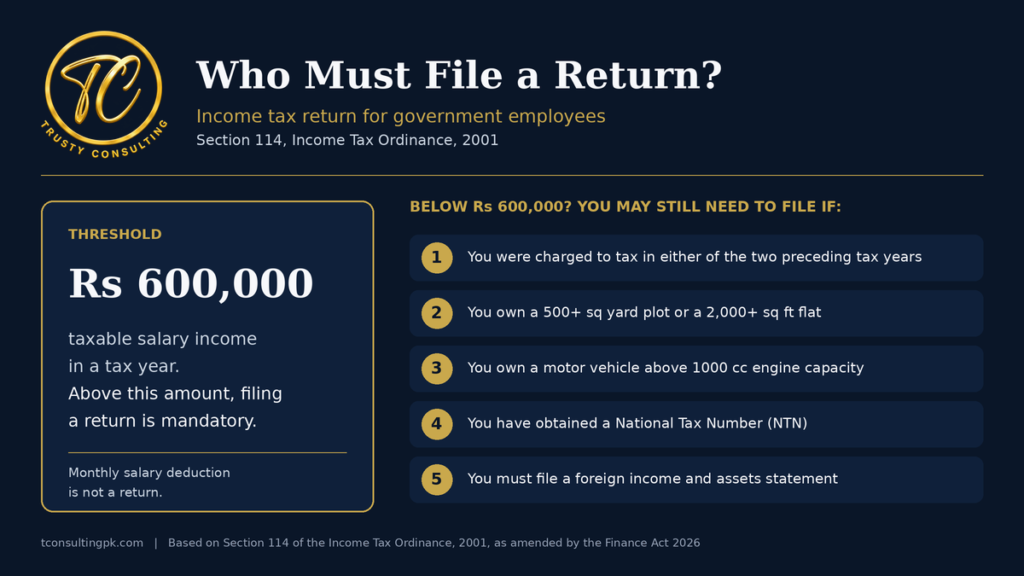
Table of Contents
Who Must File an Income Tax Return for Government Employees?
Under Section 114(1)(ab) of the Income Tax Ordinance, every individual whose taxable income exceeds the maximum amount not chargeable to tax must furnish a return. For salaried individuals that threshold is Rs 600,000 a year. Since 2013, the employer’s annual statement of tax deducted is no longer treated as a return, so a government employee cannot rely on the payslip deduction alone.
A government employee below Rs 600,000 can still be required to file under Section 114(1)(b). The conditions most relevant to salaried staff are:
- you were charged to tax in either of the two preceding tax years;
- you own immovable property of 500 square yards or more, or a flat of 2,000 square feet or more in a rating area;
- you own a motor vehicle with an engine capacity above 1000 cc;
- you have obtained a National Tax Number (NTN);
- you are a resident individual required to file a foreign income and assets statement under Section 116A.
Widows, orphans below 25 years and disabled persons are not required to file solely because of certain ownership triggers under Section 115(3), but they should still check their own position. Many employees also file voluntarily to join the Active Taxpayer List, which we explain in our guide on what a tax filer is in Pakistan.
How Government Salary Is Taxed and Reconciled
Section 12 defines salary broadly. It includes pay, leave pay, bonus, gratuity, pension, allowances and perquisites, whether or not they can be converted to cash. Allowances are taxable unless they are solely expended in performing your duties. The law clarifies that an allowance paid monthly on a fixed basis, or as a percentage of salary, does not qualify as solely expended.
Your drawing and disbursing office deducts tax under Section 149 at your average rate, computed on your estimated annual salary. That deduction is adjustable. The income tax return for government employees reconciles your actual annual salary against the tax deducted so that any excess is credited, and any shortfall is paid with the return. For a wider explanation of salary heads, see our salary income tax in Pakistan guide.
Perquisites provided by the department
Section 13 values employer-provided benefits such as a vehicle for private use, housing, utilities and domestic staff. These are added to taxable salary, reduced by anything you pay for them. Officers using official accommodation or vehicles should obtain the correct valuation from the accounts office before filing.
The 75% salary rule
Salaried-individual slabs apply where your salary exceeds 75% of your taxable income. If you also earn substantial rent or business income, the ordinary individual rates may apply to the whole of your income instead.
Salary Tax Slabs: Tax Year 2026 and Tax Year 2027
The Finance Act 2026 reduced the upper salary slabs. The Ordinance text confirms the revised table, and the FBR withholding tax rate card updated to 30 June 2026 shows the same rates. An income tax return for government employees for Tax Year 2026, including a late one, is still computed under the earlier Finance Act 2025 slabs.
| Taxable salary (Rs per year) | Tax Year 2026 (Finance Act 2025) | Tax Year 2027 (Finance Act 2026) |
|---|---|---|
| Up to 600,000 | Nil | Nil |
| 600,001 to 1,200,000 | 1% of the amount above 600,000 | 1% of the amount above 600,000 |
| 1,200,001 to 2,200,000 | Rs 6,000 + 11% above 1,200,000 | Rs 6,000 + 11% above 1,200,000 |
| 2,200,001 to 3,200,000 | Rs 116,000 + 23% above 2,200,000 | Rs 116,000 + 20% above 2,200,000 |
| 3,200,001 to 4,100,000 | Rs 346,000 + 30% above 3,200,000 | Rs 316,000 + 25% above 3,200,000 |
| 4,100,001 to 5,600,000 | Rs 616,000 + 35% above 4,100,000 | Rs 541,000 + 29% above 4,100,000 |
| 5,600,001 to 7,000,000 | Rs 616,000 + 35% above 4,100,000 | Rs 976,000 + 32% above 5,600,000 |
| Above 7,000,000 | Rs 616,000 + 35% above 4,100,000 | Rs 1,424,000 + 35% above 7,000,000 |
Very high earners should separately confirm whether any surcharge applies for the year in question.
Illustrative example (hypothetical)
A grade-17 officer has a taxable salary of Rs 3,000,000 and no other income. Tax of Rs 300,000 on that salary under the Tax Year 2026 slabs (116,000 + 23% of 800,000) falls to Rs 276,000 under the Tax Year 2027 slabs (116,000 + 20% of 800,000). Figures exclude tax credits.
| Annual taxable salary | Tax Year 2026 | Tax Year 2027 |
|---|---|---|
| Rs 1,800,000 | Rs 72,000 | Rs 72,000 |
| Rs 3,000,000 | Rs 300,000 | Rs 276,000 |
| Rs 4,500,000 | Rs 756,000 | Rs 657,000 |
Pension, GP Fund and Gratuity in Your Income Tax Return for Government Employees
Retirement benefits are where a government return differs most from a private-sector one. Here is how each receipt is treated.
- Pension: pension is salary under Section 12(2)(f). Pension received from a former employer is taxed at 0% up to Rs 10 million a year, and at 5% only on the excess. A person aged 70 or above is not charged tax on pension income. A pensioner who keeps working for the former employer is taxed at ordinary salary rates.
- Provident fund: payments from a provident fund to which the Provident Funds Act, 1925 applies are exempt under the Second Schedule, Part I, clause (22). The accumulated balance of a recognised provident fund is exempt under clause (23).
- Leave preparatory to retirement: encashment is exempt for employees of the Federal or a Provincial Government under clause (19).
- Gratuity: for a government employee, the amount receivable under the service rules is exempt under the gratuity clause of Part I of the Second Schedule.
- Benevolent grant: grants from the Central Employees Benevolent Fund under the 1969 Act are exempt under clause (24).
Even an exempt receipt should be reported in the correct field so that your wealth statement reconciles.
Arrears and Pay Revisions
Arrears of pay can push you into a higher slab in a single year. Section 12(7) lets an employee elect, by written notice to the Commissioner, to tax arrears at the rates that would have applied in the year the services were rendered. Under Section 12(8), the election must be made by the due date for filing the return, unless the Commissioner allows later. Anyone who received pay-scale arrears should raise this before filing the income tax return for government employees, not after.
Tax Credits and Allowances You May Claim
Several credits can reduce the tax shown on an income tax return for government employees, provided you hold the supporting evidence.
- Charitable donations (Section 61): a tax credit for donations to qualifying education boards, universities, government-run hospitals or relief funds, and approved non-profit organisations. Keep official receipts.
- Approved pension fund contributions (Section 63): an eligible salaried person can claim a credit for contributions to a pension fund approved under the Voluntary Pension System Rules, 2005.
- Education expenses (Section 60D): a deductible allowance applies subject to conditions. Our Section 60D guide explains how it works.
- Teachers and researchers: Part III of the Second Schedule gave a 25% tax reduction to full-time teachers and researchers, but the Ordinance text states that it ceases after Tax Year 2025. Confirm the current position before claiming it.
Documents You Need for Your Income Tax Return for Government Employees
- CNIC and NTN registration details with IRIS login
- Annual salary certificate or tax deduction statement from your accounts office
- Monthly salary slips, showing allowances and deductions
- Pension and GP Fund statements, if retired or receiving benefits
- Bank statements and records of property, vehicles, savings and prize bonds
- Donation receipts and pension fund contribution proof
- Opening and closing wealth details, including spouse, minor children and dependents
Step-by-Step: How to File Your Income Tax Return for Government Employees
- Register on IRIS at the FBR portal using your CNIC and mobile number if you do not already have an NTN.
- Obtain your salary certificate from the drawing and disbursing office or accounts office showing gross salary and tax deducted.
- Select the correct return for the tax year under the Declaration menu and choose the salaried individual return.
- Enter salary and withholding under the correct heads. FBR guidance has used separate codes for federal and provincial government salary tax deducted, so use the one that matches your employer.
- Prepare your wealth statement and reconcile it. Our wealth statement guide explains Section 116.
- Claim only verified credits. Section 182 now penalises claiming withholding credit above the amount verifiably deducted and deposited.
- Review, pay any balance, submit and save the acknowledgement. Then check that your name appears on the ATL.
Deadline for the Income Tax Return for Government Employees and ATL Status
Section 118(3) fixes 30 September as the due date for individuals. FBR has the power to extend it under Section 214A, and did so for Tax Year 2026, first to 15 October and then to 31 October 2026. Extensions are not guaranteed, so plan to file before 30 September.
If you miss the date, Section 182A removes you from the ATL for that year. You can return to the list after filing if you pay a surcharge of Rs 25,000 as an individual. Refunds are not issued while you are off the list. An individual may avoid the surcharge by giving the Commissioner an undertaking not to acquire property for six months. Our article on tax filers and non-filers covers the consequences of ATL status.
Penalties for Late or Incorrect Filing
| Default | Penalty under Section 182 |
|---|---|
| Late return | Higher of 0.1% of tax payable per day or Rs 1,000 per day, with a minimum of Rs 10,000 for an individual with 75% or more salary income, and a maximum of 200% of tax payable |
| Reduction for filing within three months | Penalty reduced by 75%, 50% or 25% if the return is filed within one, two or three months after the due or extended due date |
| Wealth statement not furnished | Higher of 0.1% of taxable income per week or Rs 100,000 |
| Excess withholding credit claimed | Penalty equal to the excess credit claimed, introduced by the Finance Act 2026 |
Penalties are imposed by a written order after a hearing, and a taxpayer who admits default may pay voluntarily. When the Federal Government notifies the restrictions under Section 114C, persons who are not on the ATL may also face limits on certain vehicle, property and investment transactions above the Fifteenth Schedule thresholds.
Common Mistakes Government Employees Make
- Assuming monthly deduction replaces a return.
- Reporting gross pay without the perquisite value of official housing or vehicles.
- Missing the arrears election under Section 12(7).
- Claiming a tax credit or allowance without a receipt.
- Leaving out a spouse’s or dependent’s assets from the wealth statement.
- Selling a plot or shares and omitting the gain, which our capital gains tax guide covers.
- Filing after the due date and discovering ATL surcharge and penalties only later.
How Trusty Consulting Can Support Your Return
Trusty Consulting, based in Sialkot, prepares and files the income tax return for government employees, including pensioners, and handles NTN registration and wealth statement reconciliation. Our team can:
- review your salary certificate against your payslips;
- identify exempt receipts and the correct treatment of arrears;
- prepare a reconciled wealth statement;
- file your return on IRIS and confirm your ATL status;
- help you respond to FBR notices.
We explain the likely outcome before filing, and we do not promise refunds or particular results.
Frequently Asked Questions
Do government employees have to file an income tax return if tax is already deducted?
Yes, if taxable income exceeds Rs 600,000 or another Section 114 condition applies. Section 149 deduction is adjustable, and the return is how you claim credit for it.
What is the deadline for an income tax return for government employees?
The statutory due date is 30 September after the tax year. For Tax Year 2026, FBR extended it to 31 October 2026. Tax Year 2027 is due by 30 September 2027 unless extended.
Is a government pension taxable?
Pension is salary under Section 12, but pension from a former employer is taxed at 0% up to Rs 10 million a year, with 5% on the excess. A person aged 70 or above is not charged tax on pension income.
Are GP Fund and leave encashment taxable?
Payments from a provident fund covered by the Provident Funds Act, 1925 are exempt, and so is leave preparatory to retirement encashment for Federal and Provincial Government employees.
What happens if I file my return late?
You face a Section 182 penalty, with a Rs 10,000 minimum for most salaried individuals, and you drop off the ATL for that year until you file and pay the Rs 25,000 individual surcharge.
Can I claim a donation as a government employee?
Yes, a tax credit under Section 61 is available for qualifying donations, calculated by the statutory formula. Keep receipts from the recipient institution.
How are arrears taxed?
Under Section 12(7) you may elect to have arrears taxed at the rates that applied in the years they relate to, by written notice before the return due date.
Which documents do I need for an income tax return for government employees?
Keep your annual salary certificate, payslips, pension or GP Fund statements, bank records, property and vehicle details, and receipts for any donations or pension fund contributions.
Do I need a wealth statement?
Yes. The return must be accompanied by a wealth statement under Section 116, and the statement covers assets and liabilities, including those of your spouse, minor children and dependents.
Conclusion
A correct income tax return for government employees protects your ATL status, avoids Section 182 penalties and lets you claim every credit and exemption you are entitled to. Start from your salary certificate, apply the right tax year slabs, treat pension and provident fund receipts correctly, and file on IRIS before 30 September. Filing early is the simplest way to keep your income tax return for government employees free of penalties.
Official References
- Federal Board of Revenue (FBR)
- FBR IRIS taxpayer portal
- FBR Withholding Tax Rates Card, updated to 30 June 2026
- Income Tax Ordinance, 2001, as amended by the Finance Act, 2026: Sections 12, 13, 60D, 61, 63, 114, 115, 116, 118, 149, 182, 182A and the First and Second Schedules
Disclaimer
This article is general information based on the Income Tax Ordinance, 2001 as amended up to the Finance Act, 2026, and FBR publications available at the time of writing. Tax law, rates and deadlines change, and individual circumstances differ. It is not legal or tax advice. Please consult a qualified tax professional before filing.