
 UAE
 Saudi Arabia
 Qatar
 Oman
 Bahrain
 Kuwait
 Lebanon
 Ghana
 UK
 Ireland
 Germany
 France
 Netherlands
 Belgium
 Luxembourg
 USA
 Canada
 Australia
 New Zealand
 Singapore
 Malaysia
 Hong Kong

Education tax relief Pakistan taxpayers can actually claim sits in Section 60D of the Income Tax Ordinance, 2001, and it is smaller and more conditional than most families expect. It is not a refund of school fees. It is a capped deductible allowance on tuition fees, available only to individuals whose taxable income is below Rs 1.5 million.
This guide explains who qualifies, how the three statutory limits work, how to claim the allowance in your return and which mistakes cost families money. It was reviewed on 27 November 2026 against the Ordinance as updated to 30 June 2026, and we found no change to Section 60D in the Finance Act, 2026.
Education Tax Relief Pakistan: Key Information at a Glance
| Item | Position under Section 60D |
|---|---|
| Legal basis | Section 60D, Income Tax Ordinance, 2001 (deductible allowance for education expenses) |
| Type of relief | Deductible allowance, not a tax credit |
| Who can claim | Individuals with taxable income of less than Rs 1,500,000 |
| What is covered | Tuition fee paid by the individual in the tax year |
| Maximum claim | Lowest of 5% of tuition fee, 25% of taxable income, or Rs 60,000 multiplied by the number of children |
| Carry forward | Not allowed; unused allowance lapses |
| Who claims | Either parent who pays the fee |
| Proof required | NTN or name of the educational institution |
| Salary withholding | Not taken into account under Section 149, so it is claimed in the return |
Table of Contents
What Is Education Tax Relief in Pakistan?
Many people search for an “education tax credit” or a “tuition fee rebate”. Legally, neither term appears in the Ordinance. The education tax relief Pakistan law provides is a deductible allowance under Section 60D, titled “Deductible allowance for education expenses”.
The difference matters. A tax credit, such as the donation credit in Section 61, reduces the tax itself. A deductible allowance is taken off in arriving at the income on which tax is calculated. Your real saving is therefore linked to your tax slab, not to the full allowance amount, and the final figure is computed by the return software.
The provision was originally numbered Section 64AB and was renumbered as Section 60D by the Finance Act, 2017. The same Act raised the income ceiling to Rs 1.5 million, which is where it stands today.
Who Can Claim Education Tax Relief in Pakistan?
Not every taxpayer qualifies for education tax relief Pakistan offers. Under Section 60D, the allowance is available when all of the following conditions are met:
- The claimant is an individual. Companies and associations of persons are outside the section.
- The individual has paid tuition fee in the relevant tax year.
- The individual’s taxable income is less than Rs 1,500,000. A taxable income of exactly Rs 1,500,000 does not satisfy “less than”.
- The claim is made against the liability of either parent who actually pays the fee.
- The claimant furnishes the NTN or the name of the educational institution.
Because the allowance is claimed through the income tax return, you must file a return to benefit from it. If you are not yet on the filer list, our Trusty Consulting team can help you register and file first.
One practical point: the third limit in the section multiplies Rs 60,000 by the number of children. A taxpayer with no children may therefore find the allowance computes to nil, even if tuition fee is paid for another person. Confirm your position before relying on it.
The 3 Limits on Education Tax Relief Pakistan Allows
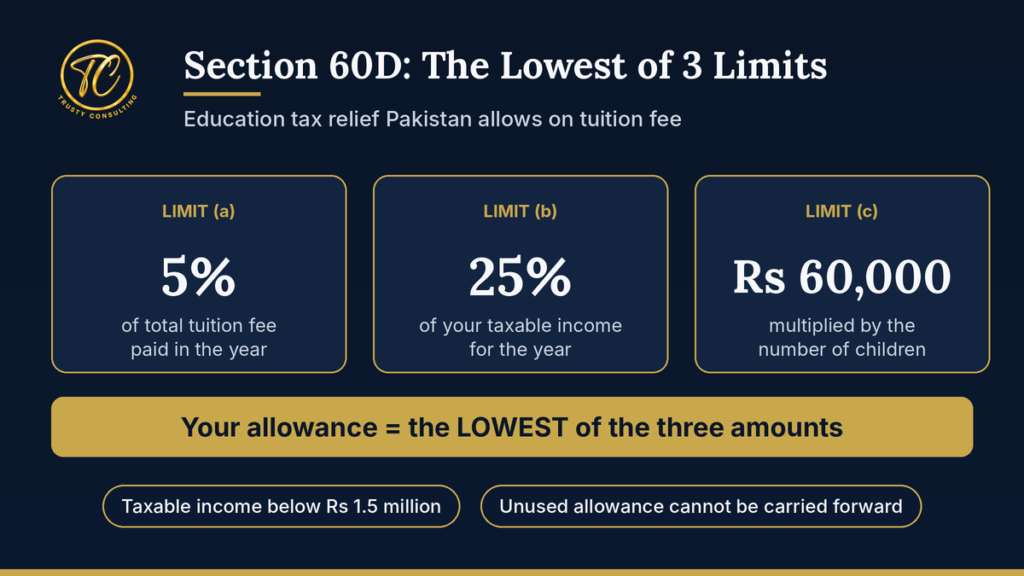
Section 60D does not allow the whole fee. The allowance cannot exceed the lowest of three amounts:
| Limit | Rule | In plain words |
|---|---|---|
| Limit (a) | 5% of the total tuition fee paid in the year | One-twentieth of the fee |
| Limit (b) | 25% of the person’s taxable income for the year | Protects against claims larger than a quarter of income |
| Limit (c) | Rs 60,000 multiplied by the number of children | A fixed ceiling per child |
In other words, education tax relief Pakistan allows is a small percentage of the fee, not the fee itself. For most families, limit (a) is the smallest. If average tuition per child is Rs 1.2 million or less, 5% of the fee is below Rs 60,000 per child. Limit (c) bites only when fees are higher, and limit (b) matters mainly at very low taxable incomes.
Any part of the allowance that cannot be deducted in the year is lost. Section 60D(3) does not allow it to be carried forward to a later tax year.
Worked Examples of Education Tax Relief in Pakistan
These examples of education tax relief Pakistan taxpayers may claim are hypothetical and use invented names. They are not client cases.
Example 1: A salaried supervisor in Sialkot
Hamza Tariq works as a quality supervisor at a surgical instruments unit in Sialkot. His taxable income is Rs 1,200,000 and he paid Rs 480,000 in tuition fee for his two children.
| Test | Calculation | Result |
|---|---|---|
| 5% of tuition fee | 5% × Rs 480,000 | Rs 24,000 |
| 25% of taxable income | 25% × Rs 1,200,000 | Rs 300,000 |
| Rs 60,000 × children | Rs 60,000 × 2 | Rs 120,000 |
| Allowance allowed | Lowest of the three | Rs 24,000 |
Example 2: A workshop owner just above the ceiling
Saima Rauf runs a small stitching workshop in Sialkot that supplies sports goods exporters. Her taxable income is Rs 1,650,000 and she pays Rs 600,000 in annual tuition fee. Because her taxable income is not less than Rs 1,500,000, she cannot claim any allowance under Section 60D, however high the fee.
Example 3: One child, high school fee
A parent with taxable income of Rs 1,400,000 pays Rs 1,500,000 in tuition fee for one child. The 5% test gives Rs 75,000 and the income test gives Rs 350,000, but the child limit is Rs 60,000. The allowance is therefore capped at Rs 60,000.
What Counts as Tuition Fee?
For education tax relief Pakistan claims, Section 60D refers to “tuition fee” only. In the text we reviewed, it does not extend the allowance to admission fees, transport, uniforms, books or boarding. School vouchers often combine several charges, so ask the institution to show tuition fee separately and keep every voucher and receipt.
If a fee structure is unclear, ask your tax adviser before claiming. An over-claim can be disallowed and may attract questions in assessment.
How to Claim Education Tax Relief Pakistan Step by Step
- Collect fee evidence. Gather vouchers or receipts for the tax year showing the institution’s name and, where available, its NTN.
- Separate tuition fee from other school charges.
- Confirm your taxable income. It must be below Rs 1,500,000.
- Compute the three limits and take the lowest figure.
- Enter the amount in your return under deductible allowances. FBR’s individual return format has carried a line for “Educational expenses u/s 60D”; check the current-year form on the FBR IRIS portal.
- Keep records for the period required by the Ordinance in case of audit or notice.
Return deadlines and forms change by tax year, so check the Federal Board of Revenue (FBR) website for the current position before you claim education tax relief Pakistan allows.
Salaried Taxpayers: Why Your Employer’s Deduction Ignores the Allowance
Education tax relief Pakistan offers to employees works differently from monthly withholding. Section 60D(5) says the allowance is not taken into account when computing tax deduction under Section 149, the salary withholding provision. In practice, your employer deducts monthly tax without considering your children’s tuition fee.
The benefit therefore arrives when you file your return. Claim the allowance there, and the final liability is computed after it. If tax withheld during the year exceeds the final liability, the excess is dealt with through the return and refund process.
Education Tax Relief vs Other Education-Related Provisions
Several other provisions are often confused with Section 60D. The table below separates them.
| Provision | Nature | Position |
|---|---|---|
| Section 60D | Deductible allowance on tuition fee | Available for individuals with taxable income below Rs 1.5 million |
| Section 61 | Tax credit for donations | Covers donations to specified education boards, universities, government educational institutions, non-profits and Thirteenth Schedule entities; computed by formula |
| Section 47 | Exemption for scholarships | A separate exemption; check its conditions for your case |
| Section 236I | Advance tax on school fees | Omitted by the Finance Act, 2022; not collected under that section |
| Clause (3A), Part III, Second Schedule | 25% tax reduction for qualifying full-time teachers | Stated to cease after tax year 2025 |
5 Costly Mistakes with Education Tax Relief Pakistan Families Make
- Expecting the full fee back. The allowance is usually about 5% of tuition fee, and the tax saving is less than that.
- Ignoring the income ceiling. Taxable income of Rs 1,500,000 or more removes the allowance completely.
- Hoping to carry it forward. Unused allowance lapses at year end.
- Having no proof. The section requires the NTN or the name of the institution; missing vouchers weaken the claim.
- Calling it a credit. Using the wrong term can lead to the figure being entered in the wrong place. Ask for the “Section 60D tuition fee allowance”.
How Trusty Consulting Can Support Your Return
As a Sialkot tax consultant firm, Trusty Consulting helps individuals and business owners prepare income tax returns, organise supporting documents and review whether education tax relief Pakistan allows under Section 60D applies to you. Our team can also review your wider tax position, including salary, business and property income, so the allowance is claimed correctly alongside everything else in your return.
We do not promise particular savings or outcomes. We check the law, your documents and your taxable income, and then explain what you can claim.
Frequently Asked Questions on Education Tax Relief Pakistan
Is there an education tax credit in Pakistan?
Not in the strict sense. The education tax relief Pakistan provides is a deductible allowance on tuition fee under Section 60D of the Income Tax Ordinance, 2001.
Who is eligible for education tax relief Pakistan allows under Section 60D?
An individual whose taxable income is less than Rs 1,500,000 and who has paid tuition fee in the tax year. Either parent who pays the fee can claim.
How much education tax relief can I claim?
The lowest of 5% of tuition fee paid, 25% of taxable income, and Rs 60,000 multiplied by the number of children.
Can I carry forward unused education allowance?
No. Section 60D(3) does not allow any unused part to be carried forward.
Do both parents get the allowance?
The section allows the claim against the liability of either parent who makes the payment. Claim it on the return of the parent who actually paid the fee, and keep proof of that payment.
Does my employer apply the allowance to my monthly salary tax?
No. Under Section 60D(5) the allowance is not taken into account for deduction under Section 149, so you claim it when filing your return.
Has the Finance Act, 2026 changed Section 60D?
We found no amendment to Section 60D in the Finance Act, 2026, and the Ordinance as updated to 30 June 2026 retains the same limits. Always check the current-year position before filing.
Can a Sialkot taxpayer get help with claiming the allowance?
Yes. A Sialkot tax consultant can check eligibility, compute the limits and file the return for you. Contact Trusty Consulting on WhatsApp to discuss your case.
Conclusion
Education tax relief Pakistan offers under Section 60D is real but narrow. It applies only to individuals with taxable income below Rs 1.5 million, it is capped at the lowest of three limits, and it cannot be carried forward. Most Sialkot families will find that 5% of tuition fee is the limit that applies, so the benefit is modest, but it is worth claiming correctly with proper records.
Before you file, confirm your taxable income, separate tuition fee from other charges and keep every receipt. If you would like a professional check, speak to our team.
Disclaimer
This article is for general information only and is not legal or tax advice. Tax law, forms and deadlines change, and your facts may differ. Please obtain professional advice before acting. Reviewed on 27 November 2026 against the Income Tax Ordinance, 2001 as updated to 30 June 2026.