
 UAE
 Saudi Arabia
 Qatar
 Oman
 Bahrain
 Kuwait
 Lebanon
 Ghana
 UK
 Ireland
 Germany
 France
 Netherlands
 Belgium
 Luxembourg
 USA
 Canada
 Australia
 New Zealand
 Singapore
 Malaysia
 Hong Kong
Income from other sources is the catch-all head of income under Section 39 of the Income Tax Ordinance, 2001. It covers dividends, bank profit, royalty, annuities, prizes, certain gifts and loans, and many other receipts that do not belong to salary, business, property or capital gains. Many taxpayers in Pakistan miss these amounts in their returns, and the FBR can add them to taxable income later. This guide explains what is covered, how it is taxed, which deductions apply and where mistakes usually happen.
Income from Other Sources at a Glance
| Point | Summary |
|---|---|
| Governing provision | Section 39 (charging) and Section 40 (deductions), Income Tax Ordinance, 2001 |
| Basic rule | Income of every kind not covered by another head and not exempt is taxed under this head |
| Typical items | Dividend, profit on debt, royalty, pension or annuity, prizes, ground rent, certain gifts and loans |
| Key trap | Cash loans and gifts above the banking-channel rule can be treated as income |
| Finance Act 2026 | FBR Circular No. 02 of 2026-27 shows no amendment to Section 39 itself |
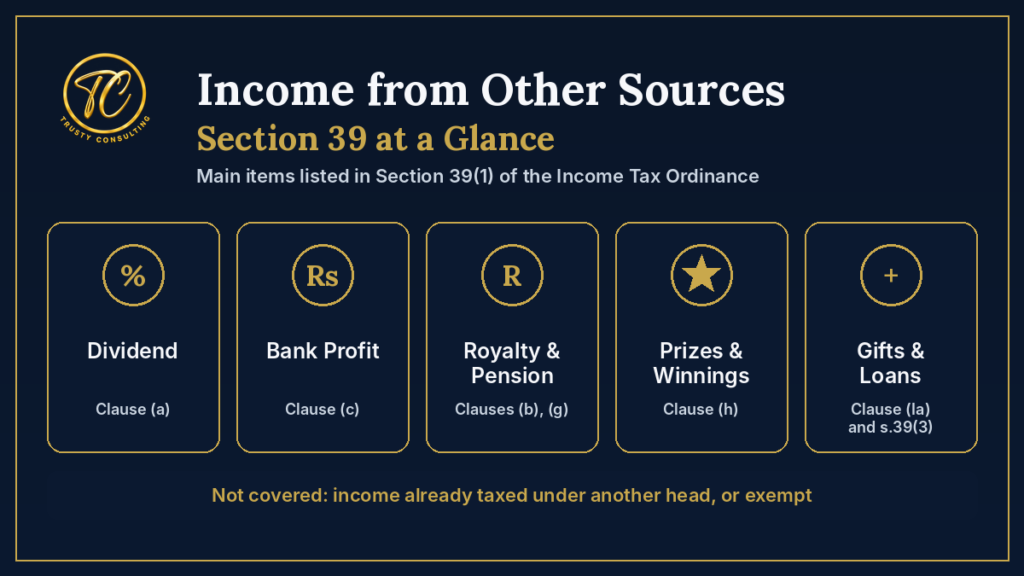
Table of Contents
What Is Income from Other Sources?
Pakistan taxes income under five heads: salary, income from property, income from business, capital gains and income from other sources. Section 39 works as the residual head. Income of every kind received in a tax year is chargeable under it if it is not included in any other head and is not exempt under the Ordinance.
This means income from other sources is not a short fixed list. The statute gives examples, but the opening words are wide. Any receipt that has the character of income and fits no other head can fall here.
Section 39(5) adds an important limit. The section does not apply to income that is chargeable under another head, or that is subject to tax under sections 5, 5AA, 6, 7 or 7B. That is why some dividends and bank profits are taxed through separate tax blocks instead of ordinary slab rates.
Items Covered Under Section 39
Section 39(1) lists the main items. The list uses the word “including”, so it is illustrative and not exhaustive.
| Item | Section 39(1) reference |
|---|---|
| Dividend | Clause (a) |
| Royalty | Clause (b) |
| Profit on debt (for example, bank profit) | Clause (c) |
| Additional payment on delayed refund under any tax law | Clause (cc) |
| Ground rent | Clause (d) |
| Rent from sub-lease of land or building | Clause (e) |
| Lease of a building together with plant or machinery | Clause (f) |
| Amenities, utilities or services connected with renting a building | Clause (fa) |
| Annuity or pension | Clause (g) |
| Prize bond, raffle, lottery, quiz, promotional prize or crossword winnings | Clause (h) |
| Consideration for use or exploitation of property, including natural resource rights | Clauses (i) and (j) |
| Amount received for vacating possession of a building | Clause (k) |
| Amounts from an approved income payment plan or annuity plan under the Voluntary Pension System Rules, 2005 | Clause (l) |
| Gift of money or property, other than from a relative as defined in section 85(5) | Clause (Ia) |
| Income to a shareholder from issuance of bonus shares | Clause (lb) |
Two related points are worth remembering. First, rent from a building leased together with plant and machinery is taken out of “Income from Property” by section 15(3) and falls under income from other sources. Second, amounts charged for amenities or utilities inside the rent are also treated under this head by section 15(3A).
Gifts, Loans and Advances: Section 39(3)
This is the part of income from other sources that causes the most disputes. Under section 39(3), a loan, advance, deposit for issuance of shares, or gift received in a tax year from another person is treated as income if it is not received through a banking channel from a person holding an NTN.
The Ordinance, as amended up to the Finance Act 2025, allows the safe route to include a crossed cheque, a banking channel or digital means as defined in section 2. The lender must also be a person holding a National Tax Number. A bank or financial institution as the lender is outside the rule.
- Cash received from a friend or a business associate can be added to income.
- A bank transfer from a lender who has no NTN does not meet the safe route.
- Section 39(4) states that the rule does not apply to an advance payment for the sale of goods or supply of services.
- Gifts from a relative, as defined in section 85(5), are excluded from the gift clause (Ia). Keep proof of the relationship and the transfer.
Amount Received for Vacating a Building
If you receive money for giving up possession of a building or part of it, the amount, reduced by what you paid to acquire that possession, is income from other sources. Section 39(2) spreads it equally over ten tax years: the year of receipt and the following nine years. This often arises with commercial shop premises, where a tenant is paid to vacate.
Deductions Allowed Under Section 40
Income from other sources is not always taxed on the gross receipt. Section 40 allows relief in these cases:
- Expenditure: amounts paid in the year to earn the income, other than capital expenditure (section 40(1)). Expenditure is capital if its normal useful life is more than one year.
- Zakat: a person receiving profit on debt can claim Zakat paid under the Zakat and Ushr Ordinance, 1980, at the time the profit is paid (section 40(2)).
- Depreciation: where a building is leased with plant or machinery, depreciation and initial allowance are available under sections 22 and 23 (section 40(3)).
- No double claim: an expense already deducted under another head cannot be deducted again (section 40(4)).
Section 40(5) applies the general rules of section 21 to these deductions, so personal and non-business expenses remain disallowed.
How Common Items Are Taxed
Section 39 decides the head. The rate depends on the item and the machinery that applies to it. The table below uses the Ordinance as updated by the Finance Act 2026 in the project reference copy. Please confirm the position for your tax year before filing, because the rates are changed often.
| Receipt | Tax mechanism | Rate shown in the Ordinance |
|---|---|---|
| Dividend from a company | Section 150 deduction, First Schedule Part III Division I | 15% in the general case; 25% where the paying company pays no tax due to exemption, losses or tax credits |
| Dividend from mutual funds | Section 150 | 25% and 15%, based on the share of income from debt securities and equities |
| Profit on a bank account or deposit | Sections 7B and 151 | 20% of the yield or profit |
| Profit on debt in other cases | Sections 7B and 151 | 15% of the yield or profit |
Other items, such as gifts, unexplained loans, annuities and amounts for vacating a building, are generally added to the taxable income of the person and taxed at the normal rate applicable to that person. Withholding rules for prizes and winnings are separate, so check them for each receipt.
The Finance Act 2026 did change salaried individual slabs, which now start at 0% up to Rs. 600,000. That change affects the rate on ordinary income and does not rewrite Section 39. FBR explains the changes in Circular No. 02 of 2026-27.
Step-by-Step: Reporting Income from Other Sources
- List every receipt of the tax year that is not salary, business income, rent or a capital gain.
- Match each receipt to a clause of section 39(1), or confirm it belongs to another head.
- Collect withholding certificates and bank statements for dividends, profit on debt and prizes.
- Test every loan, advance and gift against the banking-channel and NTN conditions in section 39(3).
- Claim allowed deductions under section 40 with supporting records.
- Report the income in the correct section of the return and reconcile it with tax already deducted.
- Make sure the figures agree with your wealth statement and bank records.
Businesses that follow the Accounting and Financial Reporting Standard for Small-Sized Entities should also record the tax effect correctly. Section 17 of that standard uses the taxes payable method, so current income tax is recognised as an expense and a liability when due.
Practical Examples from Sialkot
The following examples are hypothetical and are provided for illustration only. They are not actual client cases.
Example 1: Cash support for a sports goods trader
A sports goods trader in Sialkot receives Rs. 2,000,000 in cash from an acquaintance to meet an urgent order. The money is not received through a banking channel. Under section 39(3), the amount can be treated as income of that year. If the same sum had come by bank transfer from a lender holding an NTN, the safe-route condition would be met, subject to documents supporting the loan.
Example 2: Bank profit of a surgical instruments exporter
An exporter earns Rs. 1,000,000 as profit on a bank deposit. At the 20% rate shown for bank deposits, tax of Rs. 200,000 is deducted by the bank. The exporter should keep the certificate and report the income and tax consistently with the bank statement.
Example 3: Amount received to vacate a shop
A shop tenant on Kashmir Road receives Rs. 5,000,000 to vacate and paid nothing to acquire possession. Under section 39(2), Rs. 500,000 is taxed each year for ten tax years.
Other Sources vs Business vs Property
| Feature | Other sources | Business income | Property income |
|---|---|---|---|
| Nature | Residual head | Trade, profession, enterprise | Rent of land or building |
| Section | 39 and 40 | 18 to 21 and related provisions | 15 and 16 |
| Deductions | Expenses to earn the income, except capital items | Wide business expenses | Specific property deductions |
| Example | Dividend, bank profit, gift | Sales profit | Shop or house rent |
7 Costly Errors to Avoid
- Taking cash loans or gifts: use a banking channel and check that the lender holds an NTN.
- Ignoring small dividends and bank profit: they must still agree with certificates and bank records.
- Misclassifying rent with plant: a building leased with machinery is not ordinary property income.
- Claiming capital expenditure: section 40 does not allow it.
- Double-claiming expenses: an expense used under another head cannot be reused.
- Forgetting the ten-year spread: vacating receipts need a yearly schedule.
- Not keeping gift evidence: relative gifts need proof of relationship and transfer.
How Trusty Consulting Can Help
If you want a Sialkot tax consultant to review your receipts, Trusty Consulting can help with income tax return filing, tax documentation and reconciliation, withholding tax compliance and tax advisory. We can also align your return with your accounts and wealth statement.
Frequently Asked Questions
What is income from other sources in Pakistan?
It is the residual head under Section 39. Income not exempt and not included in any other head is taxed here.
Is bank profit income from other sources?
Profit on debt is listed in Section 39(1)(c). Where it is subject to tax under section 7B, section 39(5) means the separate regime applies.
Are gifts taxable?
A gift is taxable under clause (Ia), except a gift from a relative as defined in section 85(5). Section 39(3) also tests gifts that are not received through a banking channel from an NTN holder.
Can I claim expenses against this income?
Yes, revenue expenditure paid to earn it is deductible under section 40, but capital expenditure is not.
Is pension income taxed here?
An annuity or pension appears in Section 39(1)(g). Pension from a former employer can instead fall under salary, as FBR explains in its Finance Act 2025 circular.
Did the Finance Act 2026 change Section 39?
FBR Circular No. 02 of 2026-27 does not show an amendment to Section 39. Always confirm rates for your tax year.
What if I receive money for vacating a shop?
The net amount is spread equally over the year of receipt and the next nine years.
Do I need a tax consultant for this?
Not always, but classification and loan or gift evidence can be technical. A professional review reduces the risk of errors.
Conclusion
Income from other sources is easy to overlook because it comes from many small receipts. Identify each item, test loans and gifts against section 39(3), claim only allowed deductions and keep documents ready. If you are unsure about a receipt, discuss it with Trusty Consulting before filing.
Disclaimer: This article is for general information and is not tax or legal advice. Tax laws and rates change; verify the position for your tax year with the FBR or a qualified professional before acting.