
 UAE
 Saudi Arabia
 Qatar
 Oman
 Bahrain
 Kuwait
 Lebanon
 Ghana
 UK
 Ireland
 Germany
 France
 Netherlands
 Belgium
 Luxembourg
 USA
 Canada
 Australia
 New Zealand
 Singapore
 Malaysia
 Hong Kong
For companies in Pakistan, November is an important period for reviewing annual corporate compliance. Businesses with a 30 June financial year-end may have completed their Annual General Meeting (AGM), but the related statutory filing process can still require attention.
SECP Annual Return Filing 2026 is particularly relevant to private limited companies, single member companies, exporters, manufacturers and other registered businesses that need to keep their corporate records updated.
An incomplete annual return, outdated director information or delayed financial statements can create regulatory complications. More importantly, these issues are often avoidable through better documentation and a properly planned compliance calendar.
In this guide, Trusty Consulting explains the key annual filing requirements, applicable deadlines, important SECP forms, common mistakes and practical steps companies can take to improve their compliance readiness.
SECP Annual Return Filing 2026: Key Information at a Glance
- Regulator: Securities and Exchange Commission of Pakistan (SECP).
- Primary law: Companies Act, 2017.
- Annual return: Section 130, with Form A or Form B as applicable.
- General annual return timeline: Within 30 days of the AGM for applicable companies, subject to company-specific rules and exemptions.
- AGM for applicable 30 June 2026 year-end companies: 28 October 2026, as highlighted by SECP.
- Financial statements: Separate preparation, audit and filing requirements may apply.
- UBO compliance: Review applicable Form 19 requirements and supporting ownership records.
Important: Annual return, financial statement and beneficial ownership obligations are not identical for every company. Always confirm the applicable requirements according to company type, financial year-end and current SECP regulations.
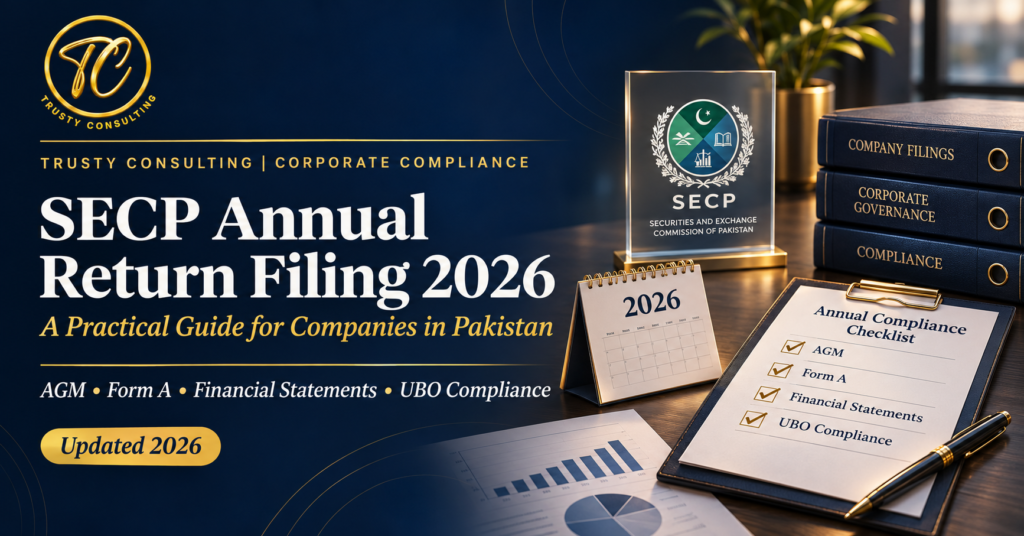
Table of Contents
- What Is an SECP Annual Return?
- AGM and Annual Filing Deadlines
- Important SECP Forms in 2026
- Financial Statements and Audit Requirements
- Annual Return Exemptions
- Step-by-Step Filing Preparation
- Practical Filing Timeline
- Common Filing Mistakes
- How Trusty Consulting Can Help
- Frequently Asked Questions
1. What Is an SECP Annual Return?
An SECP annual return is a statutory filing that provides important information about a registered company. It helps maintain an updated record of the company’s corporate particulars with the registrar.
Under Section 130 of the Companies Act, 2017, the annual return generally reflects the company’s particulars at the relevant reporting date, including the AGM date where applicable.
Information reported may include the company’s registered office, directors, chief executive, officers, auditors, members and share capital.
Understanding SECP Annual Return Filing 2026 is important for company directors and business owners who want to avoid delays, maintain accurate statutory records and meet applicable corporate compliance requirements.
According to the official SECP annual returns guidance, companies with share capital generally use Form A, while those without share capital use Form B.
Why Is Annual Return Filing Important?
Accurate corporate records support transparency and good governance. They are also useful when a business is dealing with banks, investors, professional advisers or other stakeholders who may need to verify company information.
For growing companies, the risk of inconsistent records increases when changes in shareholding, directors or management are not properly documented throughout the year.
2. SECP Annual Filing Deadlines After the AGM
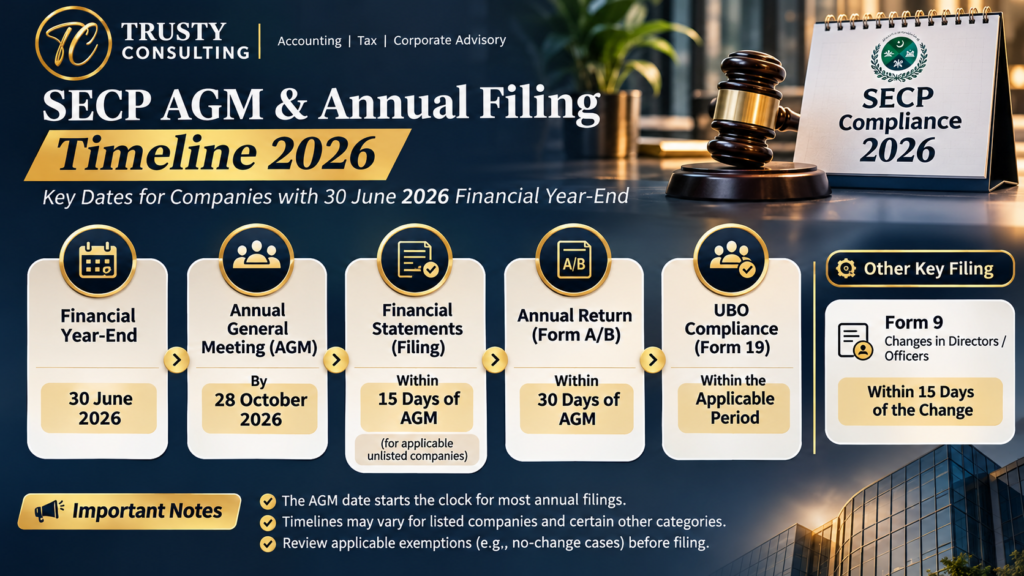
For applicable companies with a financial year ending on 30 June 2026, SECP reminded companies to hold their AGM by 28 October 2026.
The AGM date is particularly important because several subsequent filing deadlines may be calculated from that date.
However, companies should not assume that all documents have the same deadline. Annual returns, audited financial statements and event-based statutory filings may follow separate timelines.
| Compliance Requirement | General Timeline | Important Note |
|---|---|---|
| Annual General Meeting | Within the applicable statutory period after year-end | 28 October 2026 was the highlighted date for applicable 30 June 2026 year-end companies. |
| Annual Return — Form A/B | Generally within 30 days of AGM | Company category and no-change exemptions must be reviewed. |
| Audited Financial Statements | Generally within 15 days of AGM for applicable unlisted companies | Different requirements apply to listed companies and certain other categories. |
| Listed Company Financial Statements | Generally within 30 days of AGM | Additional regulatory obligations may apply. |
| UBO Compliance | Within the applicable prescribed period | Review Form 19 and related requirements. |
The filing timelines above are a general guide, not a substitute for checking the statutory position of a particular company.
3. Important SECP Forms for Annual Compliance 2026
One of the most common compliance mistakes is assuming that every company must submit the same forms. In practice, the appropriate form depends on the filing requirement and the company’s circumstances.
Form A — Annual Return of a Company with Share Capital
Form A is the annual return for companies having share capital, subject to the applicable filing conditions and exemptions.
Form B — Annual Return of a Company Without Share Capital
Form B applies to companies without share capital where an annual return is required.
Form 24 — No-Change Annual Return
Under the current statutory forms framework, Form 24 addresses applicable cases in which there has been no change in particulars since the last annual return filed with the registrar.
Its applicability should be checked before filing, especially where a company may qualify for a specific exemption.
Form 9 — Changes in Directors and Officers
SECP’s updated statutory forms include Form 9 for particulars of directors and officers and changes therein under the current Companies Regulations framework.
Older SECP guidance may still refer to Form 29. Businesses should follow the currently applicable form and electronic filing requirements rather than relying solely on older articles or checklists.
Form 19 — Ultimate Beneficial Ownership Compliance
Form 19 relates to the applicable declaration of compliance with beneficial ownership requirements. Companies should maintain accurate beneficial ownership records and review the relevant annual filing obligations.
Current forms should be checked through the SECP statutory forms directory.
4. Annual Financial Statements and Audit Requirements
Annual return filing should not be confused with the preparation and filing of financial statements. These are separate compliance areas, even though they form part of the same annual corporate reporting cycle.
Depending on the company’s classification and applicable legal provisions, the annual financial statements may require preparation, board approval, statutory audit, presentation to members and filing with the registrar.
According to SECP’s annual accounts guidance, filing timelines and audit requirements differ according to company category.
Common Financial Reporting Challenges
- Incomplete accounting records at year-end.
- Unreconciled bank and ledger balances.
- Delayed inventory or fixed asset schedules.
- Missing supporting documents for material transactions.
- Late coordination between management and external auditors.
- Financial statements not ready for timely approval.
Maintaining reliable books throughout the year can help businesses reduce the pressure of annual financial reporting and associated corporate compliance work.
5. When Can a Company Qualify for an Annual Return Exemption?
Not every registered company is required to submit a full Form A or Form B every year in every situation.
SECP guidance provides no-change relief for certain companies, including single member companies and private companies with paid-up capital not exceeding Rs. 3 million, where the prescribed particulars remain unchanged.
Other companies may be required to submit a specified no-change return rather than a full annual return.
Example: If a company’s shareholders, directors, officers, share capital or other reportable particulars have changed, management should not assume that the no-change exemption remains available.
Importantly, relief from a particular annual return does not automatically remove separate obligations concerning financial statements, beneficial ownership or event-based reporting.
6. Step-by-Step Preparation for SECP Annual Return Filing 2026
A structured filing process can reduce errors and improve the quality of information submitted to the registrar.
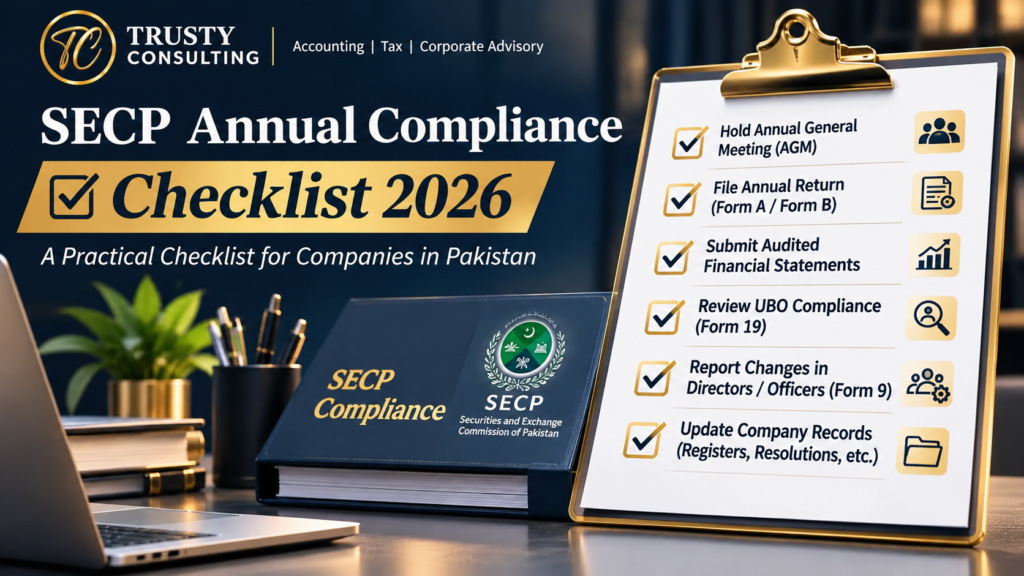
- Confirm the company category. Determine whether the entity is a private limited company, single member company, public company or another category.
- Confirm the financial year-end and AGM position. Review applicable statutory timelines and any formally approved extension.
- Update company particulars. Verify directors, chief executive, officers, registered office, members and share capital.
- Review changes made during the year. Identify events that may have required separate statutory filings.
- Prepare financial statements. Complete accounting reconciliations and coordinate statutory audit requirements where applicable.
- Review UBO information. Confirm beneficial ownership records and applicable declarations.
- Select the appropriate forms. Determine whether Form A, Form B, Form 24 or another filing is applicable.
- Complete the electronic filing. Use SECP’s applicable electronic filing platform and follow the current submission requirements.
- Save proof of submission. Retain acknowledgments, filed returns, supporting documents and relevant payment records.
For SECP Annual Return Filing 2026, companies should verify their statutory particulars, confirm the applicable annual return form and review any available exemptions before submitting documents through the SECP filing system.
7. Practical SECP Filing Timeline: A 30 June 2026 Year-End
Consider a hypothetical unlisted private limited company with a financial year ending on 30 June 2026. Assume it is required to hold an AGM, file audited financial statements and submit an annual return, and that no extension applies.
| Event | Illustrative Date |
|---|---|
| Financial year-end | 30 June 2026 |
| AGM held | 28 October 2026 |
| Audited financial statements filing deadline, assuming a 15-day rule applies | 12 November 2026 |
| Annual return filing deadline, assuming a 30-day rule applies | 27 November 2026 |
These dates illustrate how filing obligations may continue after the AGM. They should not be treated as universal deadlines: the actual date depends on the company’s circumstances, applicable filing rules and actual AGM date.
For a company that has already missed an applicable deadline, prompt review of its filing position is preferable to leaving the matter unresolved.
8. Common SECP Annual Filing Mistakes Companies Should Avoid
Mistake 1: Treating Every Filing as Having the Same Deadline
Annual returns and financial statements may be due on different dates. A company should maintain separate deadline entries for each filing requirement.
Mistake 2: Keeping Outdated Director or Shareholder Records
Changes in company particulars should be documented when they occur. Waiting until the next annual return can lead to inconsistencies and missed event-based obligations.
Mistake 3: Assuming No Business Activity Means No Compliance
A dormant or loss-making company may still have statutory obligations. Any exemption should be confirmed against the applicable law and regulatory conditions.
Mistake 4: Starting Accounts Preparation Too Late
Incomplete ledgers, missing schedules and unresolved reconciliations can delay financial statements, audit coordination and subsequent corporate reporting.
Mistake 5: Overlooking Beneficial Ownership Requirements
Companies should periodically review their ownership structures and make sure relevant UBO documentation and declarations are maintained.
Mistake 6: Failing to Preserve Filing Evidence
Submission acknowledgments, payment records, approved resolutions and supporting documents should be retained as part of the company’s permanent compliance records.
9. SECP Annual Compliance Support in Sialkot and Karachi
For exporters, manufacturers, trading companies and growing businesses in Sialkot and Karachi, corporate compliance becomes more demanding as operations expand.
Different departments may maintain financial, ownership and statutory information separately. When annual filing begins, collecting and reconciling these records can become a time-consuming exercise.
Trusty Consulting can help businesses adopt a more organized approach to corporate compliance through professional support with documentation, records review and filing coordination.
Our Corporate Compliance Support May Include
- SECP annual compliance requirements review.
- Preparation and review of relevant annual return documentation.
- Review of directors, shareholders and company particulars.
- AGM documentation and corporate records coordination.
- UBO information and relevant declarations support.
- Financial statements and accounting records coordination.
- Ongoing compliance calendar and documentation support.
Our approach focuses on understanding the company’s specific requirements rather than applying the same filing checklist to every entity.
Frequently Asked Questions About SECP Annual Return Filing 2026
What is the deadline for SECP annual return filing in 2026?
For many applicable companies, the annual return is due within 30 days of the AGM. The precise requirement depends on company category, applicable exemptions and the relevant reporting date.
What was the AGM deadline for companies with a 30 June 2026 year-end?
SECP highlighted 28 October 2026 as the AGM date for applicable companies whose financial year ended on 30 June 2026. Company-specific extensions and exemptions should be checked separately.
What is the difference between Form A and Form B?
Form A is the annual return for a company having share capital. Form B is used by companies without share capital, subject to applicable filing rules.
Does a private limited company need to file Form A every year?
Not necessarily. Certain companies may qualify for no-change relief or an exemption. The answer depends on paid-up capital, company category and whether reportable particulars have changed.
What is Form 19 in SECP compliance?
Form 19 is associated with the relevant declaration of compliance concerning ultimate beneficial ownership under the current statutory framework.
Is Form 29 still used for changes in directors?
Some older SECP guidance refers to Form 29. The updated statutory forms framework includes Form 9 for director and officer particulars and changes. Companies should verify the current applicable form before submission.
Are SECP annual returns and audited accounts the same filing?
No. The annual return reports corporate particulars, whereas financial statements concern financial reporting. Different filing obligations, timelines and exemptions may apply.
Can Trusty Consulting help with SECP annual compliance?
Yes. Trusty Consulting can assist businesses with applicable compliance reviews, statutory documentation, corporate records and filing coordination.
A well-planned approach to SECP Annual Return Filing 2026 can help businesses identify outstanding compliance requirements early, organize their corporate documentation and reduce unnecessary last-minute filing difficulties.
Conclusion: Keep Your Company’s SECP Compliance on Track
SECP Annual Return Filing 2026 is more than a year-end administrative exercise. Accurate filings depend on updated company particulars, complete financial records, timely corporate approvals and properly maintained statutory documentation.
Companies that review their compliance position throughout the year are generally better prepared to identify documentation gaps and complete applicable filings within the required periods.
If your business has outstanding statutory returns, incomplete company records or questions about the applicable annual filing requirements, professional guidance can help clarify the next steps.
Need Help with SECP Annual Compliance?
Trusty Consulting provides corporate advisory, accounting and tax support for businesses in Pakistan, including companies operating in Sialkot and Karachi.
Website: tconsultingpk.com
WhatsApp: +92 329 6325872
Locations: Sialkot & Karachi, Pakistan
Trusty Consulting — Your Professional Accounting, Tax & Corporate Advisory Partner.
Official Sources and Further Reading
- SECP: Annual General Meeting Reminder for 2026
- SECP: Annual Returns Guidance
- SECP: Annual Accounts Guidance
- SECP: Current Statutory Forms
Disclaimer: This article provides general information and is not a substitute for company-specific legal, accounting or regulatory advice. Requirements, deadlines and exemptions should be confirmed against applicable laws, SECP notifications and the company’s circumstances before filing.