
 UAE
 Saudi Arabia
 Qatar
 Oman
 Bahrain
 Kuwait
 Lebanon
 Ghana
 UK
 Ireland
 Germany
 France
 Netherlands
 Belgium
 Luxembourg
 USA
 Canada
 Australia
 New Zealand
 Singapore
 Malaysia
 Hong Kong
Choosing between the final and normal tax regimes is one of the most consequential decisions in Pakistani tax compliance, and FTR vs NTR in Pakistan is the comparison every exporter, importer, contractor and trader should understand before filing. In short, the final tax regime (FTR) closes the tax liability on a specific income at the point of withholding, while the normal tax regime (NTR) taxes your total taxable income and treats most withholding as an advance credit. Many business owners in Sialkot discover the difference only when a notice arrives.
This guide explains how each regime works under the Income Tax Ordinance, 2001, which payments are now final, minimum or adjustable, what the Finance Act 2026 changed, and how to avoid the errors we see most often.
Key Information at a Glance
The table below summarises FTR vs NTR in Pakistan before the detailed explanation.
| Point | FTR (final tax) | NTR (normal tax) |
|---|---|---|
| Basis of tax | Tax withheld on a specific receipt or transaction | Tax on total taxable income after allowable expenses |
| Effect of withholding | Closes the liability on that income (s.169) | Credit or minimum tax, adjusted in the return |
| Expenses | No deduction against final-tax income | Business expenses deductible under the Ordinance |
| Losses | Cannot be set off against final-tax income | Can be set off and carried forward as the law allows |
| Return filing | Still required if you are otherwise obliged to file | Required; refund or balance tax computed in the return |
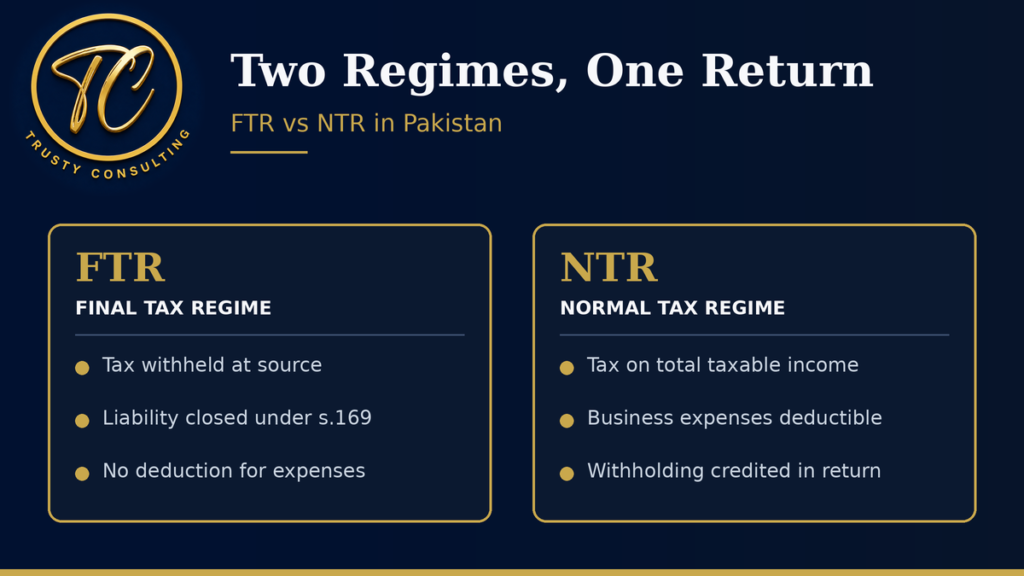
Table of Contents
Table of Contents
FTR vs NTR in Pakistan: What Is the Difference?
Pakistan taxes most business income through the normal regime: you compute taxable income, apply the relevant slab or company rate, and credit the tax already withheld by customers, banks or customs. Under the final tax regime, the tax deducted or collected is the end of the matter for that particular income. Section 169 of the Income Tax Ordinance provides that income taxed this way is not chargeable under any head of income, no deduction is allowed for related expenses, and the income cannot be reduced by losses.
That is why the regime matters commercially. A trader whose margin is thin may prefer the normal regime, where genuine expenses reduce tax. A business with high margins may find a final tax predictable and simpler. In the debate on FTR vs NTR in Pakistan, the law, however, decides the treatment for each payment, not the taxpayer, so the practical skill is knowing which category a receipt falls into.
Final, Minimum and Adjustable: The Three Treatments
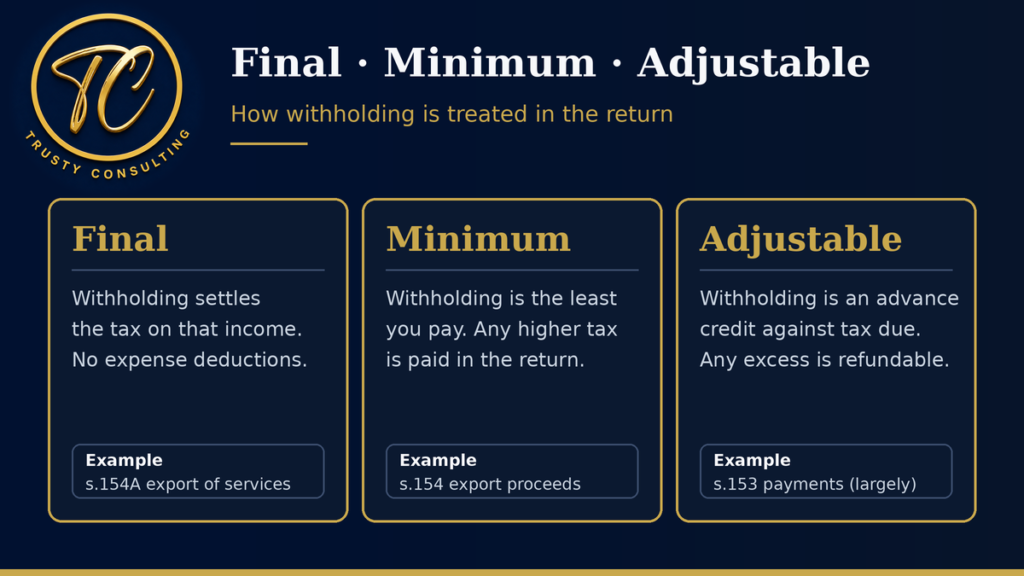
In discussions of FTR vs NTR in Pakistan, many people use “FTR” loosely for every withholding. In reality there are three treatments, and the distinction affects your return directly.
- Final tax: the withholding settles the liability. Section 169 applies, for example, to export of services under section 154A.
- Minimum tax: the withholding is the least you must pay on that income. If your normal-regime computation produces a higher figure, you pay the difference; if lower, the withheld amount stands. Export proceeds under section 154 are treated this way, because the Finance Act 2024 replaced “final” with “minimum” in section 154(4).
- Adjustable (advance) tax: the withholding is simply a credit against your final liability, refundable if it exceeds the tax due. Most payments to contractors and suppliers under section 153 fall into this group.
Always check the current text of the relevant section instead of relying on older guides. A treatment that was final five years ago may now be minimum or adjustable.
Which Payments Fall Under FTR vs NTR in Pakistan?
| Transaction | Section | Treatment (verify current year) |
|---|---|---|
| Export of goods — proceeds realised through banks | s.154 | Minimum tax |
| Export of services | s.154A | Final tax |
| Imports of goods | s.148 | Generally adjustable, with limited exceptions in the Ordinance |
| Payments for goods, services and contracts | s.153 | Largely adjustable; check the sub-section for your payment |
| Business income of a registered business | Chapter II / Part I | Normal tax regime |
This table is a simplified orientation, not a substitute for the statute. Sub-sections, thresholds and clauses of the Second Schedule can change the result for a particular taxpayer, so confirm the position for your own transaction type before relying on it.
Section 154: What Sialkot Exporters Should Know
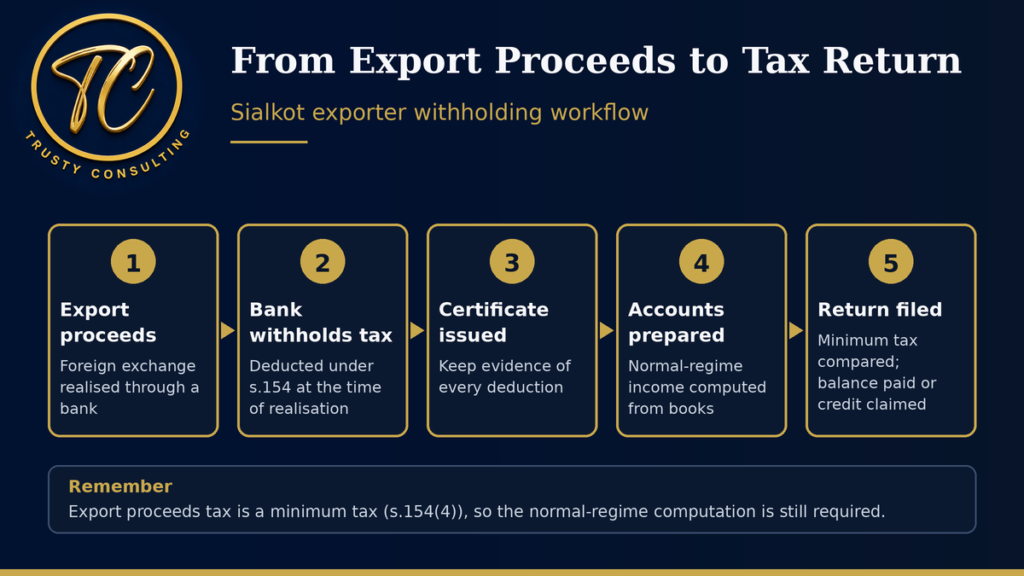
For Sialkot’s sports goods, surgical instruments, leather and garment exporters, FTR vs NTR in Pakistan becomes a practical question every time foreign exchange is realised. The authorised dealer deducts tax from the export proceeds under section 154, and under section 154(4) that deduction is a minimum tax on the export income, not a final tax.
In practical terms, an exporter should still prepare proper accounts, because the normal-regime computation decides whether any further tax is due or whether the amount already withheld is sufficient. Professional summaries of the Finance Act 2026 report that the rate on export proceeds increased from 1% to 1.25% and that the concessionary 0.25% rate for export of services was extended to tax year 2029. Confirm the exact rates and effective dates against the Finance Act text before filing.
Hypothetical illustration (not a real client): a Sialkot manufacturer realises Rs 100 million of export proceeds in a year, and Rs 1.25 million is withheld at 1.25%. If its normal-regime tax on export profit comes to Rs 0.9 million, the withheld amount stands as the minimum tax. If the computed tax is Rs 1.6 million, Rs 0.35 million remains payable.
Imports and Section 153 Withholding Under the Normal Regime
Under FTR vs NTR in Pakistan, importers pay advance tax at the customs stage under section 148, and most of this is adjusted in the annual return. Domestic payments for goods and services under section 153 are also generally treated as advance tax, which means a supplier with large withholding but low profits can end up in refund territory. Documenting each deduction with a withholding certificate is essential, because credit is granted only for tax that can be evidenced.
What Changed Under the Finance Act 2026 for FTR vs NTR in Pakistan?
- The rate of tax on export proceeds under section 154 is reported to have moved from 1% to 1.25%.
- The reduced 0.25% rate for export of services under section 154A is reported to continue until tax year 2029.
- A new opt-out mechanism under section 6A is reported for taxpayers with turnover up to Rs 200 million from tax year 2027, subject to its conditions.
- New collection and withholding provisions, including those for digital creators, were introduced.
These items are drawn from published professional summaries of the Finance Act 2026 and should be checked against the enacted text and FBR notifications before you act on them.
How to Apply FTR vs NTR in Pakistan: Step by Step
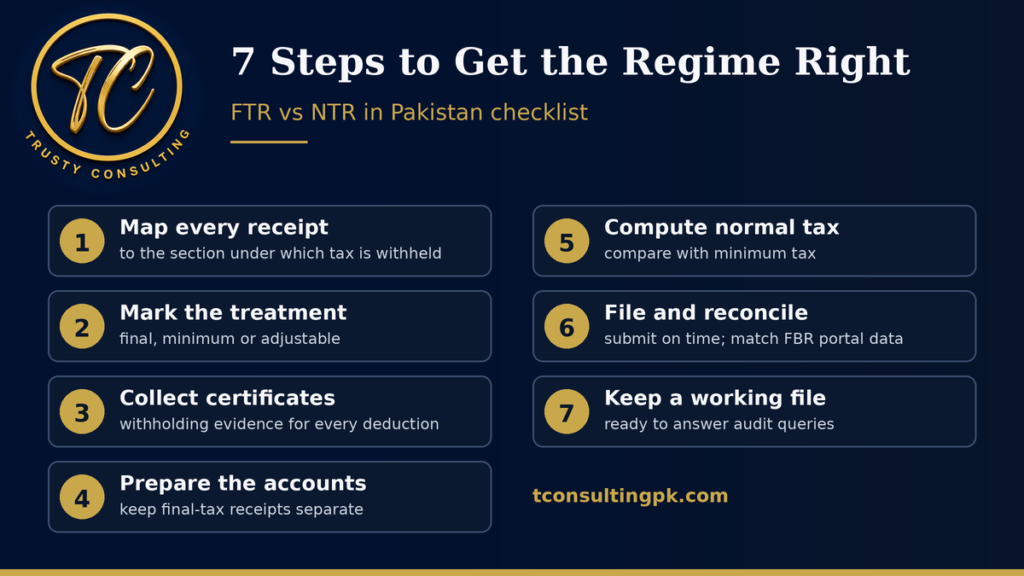
- List every receipt and map each to the section under which tax is withheld.
- Mark each as final, minimum or adjustable using the current Ordinance.
- Collect withholding certificates and bank or customs evidence for every deduction.
- Prepare accounts for the normal-regime income, keeping final-tax receipts separate.
- Compute normal tax, compare it with minimum tax, and calculate any balance or refund.
- File the return within the due date and reconcile it with your FBR portal data.
- Keep a working file so that an audit query can be answered quickly.
7 Costly Mistakes in FTR vs NTR in Pakistan Compliance
- Treating every withholding as final. Export proceeds are minimum tax, not final, so ignoring the normal computation can mean an unexpected shortfall.
- Claiming expenses against final-tax income. Section 169 denies deductions on that income.
- Mixing final and normal income in one ledger. Without separation, the return cannot be prepared correctly.
- Losing withholding certificates. Unevidenced credits are routinely questioned in audit.
- Relying on outdated books or blogs. The Finance Acts of 2024 and 2026 changed several treatments.
- Skipping the return because tax was “already deducted”. Withholding does not remove a filing obligation.
- Ignoring the sales tax interface. Income tax treatment does not remove separate sales tax duties.
How Trusty Consulting Can Help
Trusty Consulting supports businesses in Sialkot and Karachi with income tax filing, accounts for tax purposes and sales tax filing and refund support. We review how FTR vs NTR in Pakistan applies to your business, which of your receipts fall under final, minimum or adjustable treatment, reconcile withholding certificates and prepare the return on the correct basis.
If you are setting up a new business, our guide to company registration in Sialkot explains structure choices, and exporters can read how to start an export business in Sialkot. Corporate filers should also review our article on SECP annual return filing. You can browse all of our tax and accounting services or contact the team directly.
Frequently Asked Questions
What does FTR vs NTR in Pakistan mean?
FTR stands for final tax regime. Under section 169 of the Income Tax Ordinance, tax deducted on specified receipts is the full liability on that income, which is then excluded from normal taxable income.
What does NTR mean in Pakistan?
NTR is the normal tax regime, where tax is computed on total taxable income after allowable deductions and withholding is credited against the liability.
Is export tax final or minimum?
Under section 154(4), as amended by the Finance Act 2024, tax on export proceeds is a minimum tax. Export of services under section 154A is final tax.
Can I claim expenses against final-tax income?
No. Section 169 states that no deduction is allowed for expenditure incurred in deriving income taxed under the final regime.
Is withholding tax under section 153 refundable?
Where it is adjustable, any amount that exceeds your final tax liability can be claimed as a refund through the return, subject to evidence and FBR verification.
Do I still file a return if my tax is final?
Generally yes, if you are otherwise required to file. Final-tax receipts are still reported in the return even though they are not taxed again.
Is FTR vs NTR in Pakistan a choice I can make?
The law fixes the treatment of each payment, so the choice is usually not yours. What you control is accurate accounting, evidence and, where available, any opt-out the law permits.
Did the Finance Act 2026 change export tax rates?
Professional summaries report an increase on export proceeds from 1% to 1.25% and an extension of the 0.25% services rate to tax year 2029. Verify against the enacted Act.
Conclusion
Understanding FTR vs NTR in Pakistan comes down to one habit: identify how each receipt is taxed before you prepare the return. Final tax closes the liability, minimum tax sets a floor, and adjustable tax is a credit. If your records separate these cleanly and your certificates are complete, your filing becomes faster and your exposure to notices falls.
To have your own position reviewed against the current law, speak with our team.
Disclaimer
This article is for general information only and is not tax or legal advice. Tax law, rates and notifications change, and treatment depends on your facts. Please obtain professional advice before acting.