
 UAE
 Saudi Arabia
 Qatar
 Oman
 Bahrain
 Kuwait
 Lebanon
 Ghana
 UK
 Ireland
 Germany
 France
 Netherlands
 Belgium
 Luxembourg
 USA
 Canada
 Australia
 New Zealand
 Singapore
 Malaysia
 Hong Kong

An SECP late filing penalty rarely begins with a dramatic notice. It usually starts quietly: a 30-day window after the AGM passes during a busy export season in Sialkot, or a director assumes that a “no-change” company has nothing to file. By the time the delay is noticed, the cost has already started to grow.
This guide explains how the SECP late filing penalty works for companies in Pakistan, how the additional fee under section 468 of the Companies Act, 2017 increases with delay, and what to do if a return is already overdue. For the full annual calendar, read our SECP annual return filing guide first.
Table of Contents
Key Information at a Glance
| Point | What to know |
|---|---|
| Main law | Companies Act, 2017 (sections 130 and 468) |
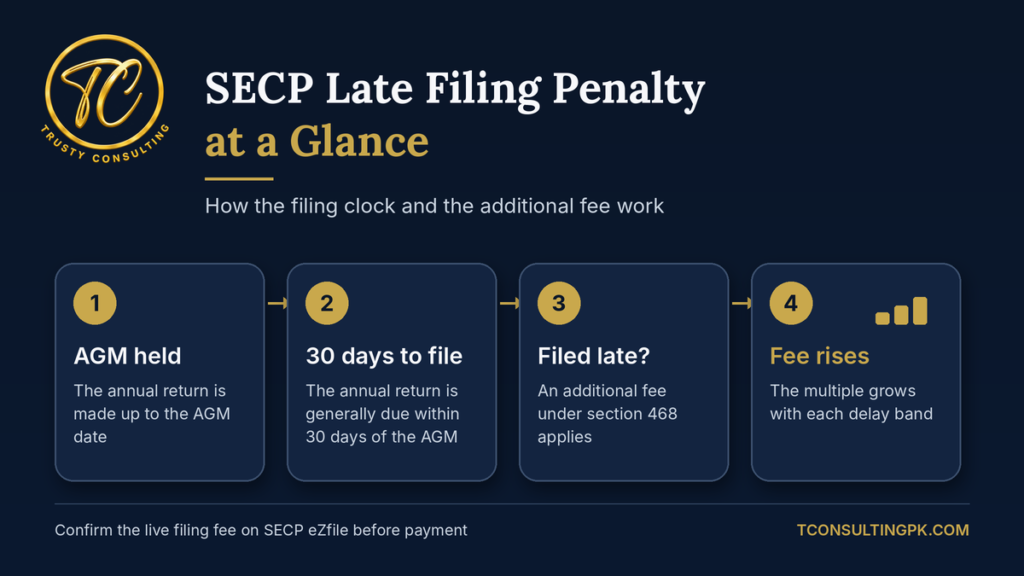
| Annual return timeline | Generally within 30 days of the AGM, as set out in SECP’s annual return guidance |
| Typical SECP late filing penalty | An additional fee, calculated as a multiple of the normal filing fee, rises with each delay band |
| AGM date for 30 June 2026 year-ends | SECP advised companies to hold the AGM by 28 October 2026 |
| Related filings | Form A or Form 24, Form-19 (UBO) and Form 9 for director or officer changes follow separate timelines |
| Rupee amounts | Always confirm the live fee on SECP’s eZfile before payment |
[INSERT IMAGE 1 HERE — SECP LATE FILING PENALTY OVERVIEW]
What Counts as Late Filing at SECP?
A document is late when it reaches the registrar after the period prescribed for it. Different filings have different clocks, so a company needs a separate deadline for each one. Knowing each clock is the first step in avoiding an SECP late filing penalty.
| Filing | Usual clock | Notes |
|---|---|---|
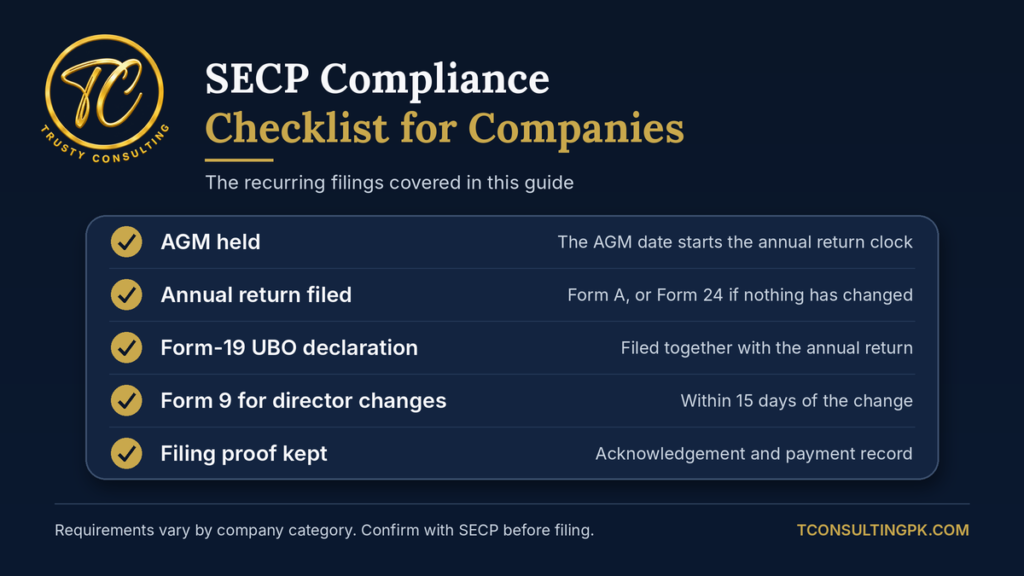
| Annual return (Form A, or Form 24 where nothing has changed) | Within 30 days of the AGM | If no AGM is held, the return is made up to the last day of the calendar year, with the same 30-day period running from that date |
| Form-19 (UBO compliance declaration) | Filed with the annual return | Where no annual return is required, it is due within 30 days of the calendar year-end |
| Form 9 (directors and officers) | Within 15 days of the change | Replaces the older Form 29 for director and officer particulars |
| Audited financial statements | Separate timeline under the Act | Not the same filing as the annual return |
For a company with a 30 June 2026 year-end, SECP advised that the AGM be held by 28 October 2026. In a hypothetical case where the AGM is held on that date, the 30-day annual return window would end on 27 November 2026. A return filed on 28 November is already late.
Some companies need not file a full annual return. SECP’s advisory exempts single member companies and private companies with paid-up capital of Rs 3 million or less where nothing has changed since the last return. Any change in members, directors or share capital removes that comfort.
How the SECP Late Filing Penalty Works: The Section 468 Additional Fee
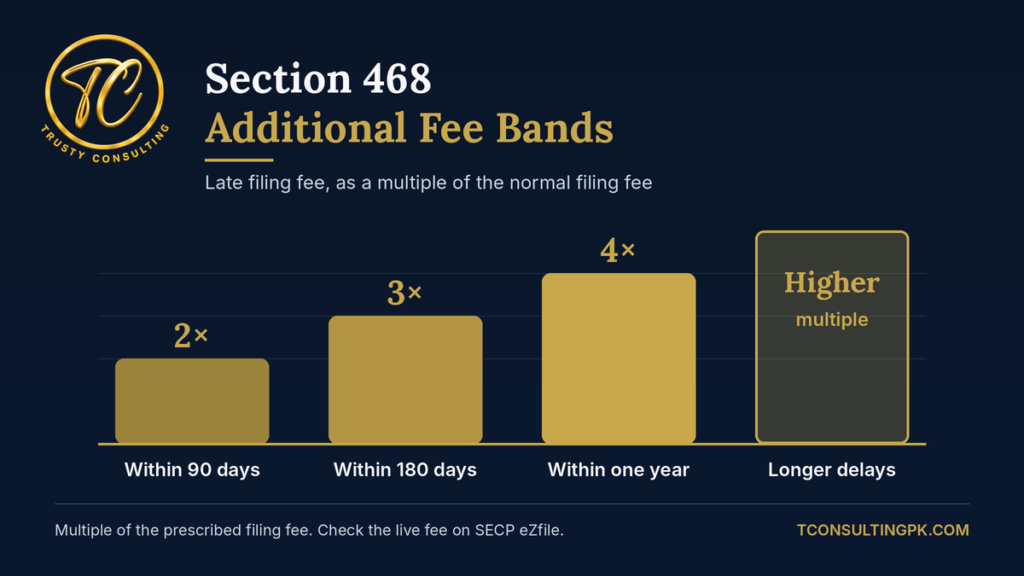
Section 468 allows the registrar to accept a document presented after the prescribed time on payment of an additional fee. As explained in SECP’s service desk FAQ, that fee is a multiple of the prescribed filing fee for the document, and the multiple rises as the delay grows.
| When the document is filed after the due date | Additional fee (multiple of prescribed filing fee) |
|---|---|
| Within 90 days | 2 times |
| Within 180 days | 3 times |
| Within one year | 4 times |
| Longer delays | Higher multiples apply; SECP’s FAQ lists 5 times for delays of up to two years. Confirm the position at the time of filing |
Illustrative example only: if a document carried a normal fee of Rs 1,000 and was filed 40 days late, the additional fee would be 2 × Rs 1,000 = Rs 2,000, payable on top of the normal fee. Actual fee amounts change, so always check the live schedule on eZfile.
In practice, the SECP late filing penalty is therefore cheapest in the first 90 days. Moving into the next band increases the additional fee without the company doing anything at all.
Is There a Separate SECP Late Filing Penalty for Not Filing?
The additional fee is the price of regularising a late document. It is not the only exposure. Under section 130(6)(b), a contravention or default in complying with the annual return requirements is an offence liable to a level 1 penalty on the standard scale, as SECP has noted in its published orders. SECP has in some cases condoned such a penalty with a warning, but a company should not plan around leniency.
Repeated default carries wider consequences. SECP has publicly stated that failure to file annual returns or financial statements for two consecutive years can lead to a company being classified as inactive under section 424, following due process. SECP has also warned that companies with overdue filings may be listed as defaulters on its website.
For exporters in Sialkot, this matters beyond regulation. Banks, buyers and sourcing partners often check a company’s corporate standing, and a defaulter listing can slow down onboarding.
5 Costly Mistakes That Lead to an SECP Late Filing Penalty
These five errors explain most avoidable cases of an SECP late filing penalty, and each can be prevented with simple controls.
1. Treating the AGM as the only date that matters
The 30-day annual return clock starts from the AGM. A company that holds its AGM late also starts the filing clock late, but the AGM itself has a statutory window. Delay at one stage compounds delay at the next.
2. Assuming “no change” means “no filing”
Form 24 and the small-company exemption apply only where particulars are genuinely unchanged. A new director, a share transfer or a change in share capital means a full Form A is needed. Check the year’s resolutions before choosing the form.
3. Forgetting Form-19 and the UBO register
Form-19 is filed with the annual return. If the UBO register is out of date, the return can be ready while the declaration is not, and the whole filing slips past the deadline.
4. Ignoring Form 9 until year-end
Director and officer changes have their own 15-day clock. Waiting for the annual return to “catch up” creates a separate late filing, with its own additional fee.
5. Leaving overdue years unresolved
An overdue year rarely stays small. Each month moves the filing towards a higher fee band, and consecutive defaults can lead to the section 424 inactive-company process described above.
Step-by-Step: What to Do If Your Return Is Overdue
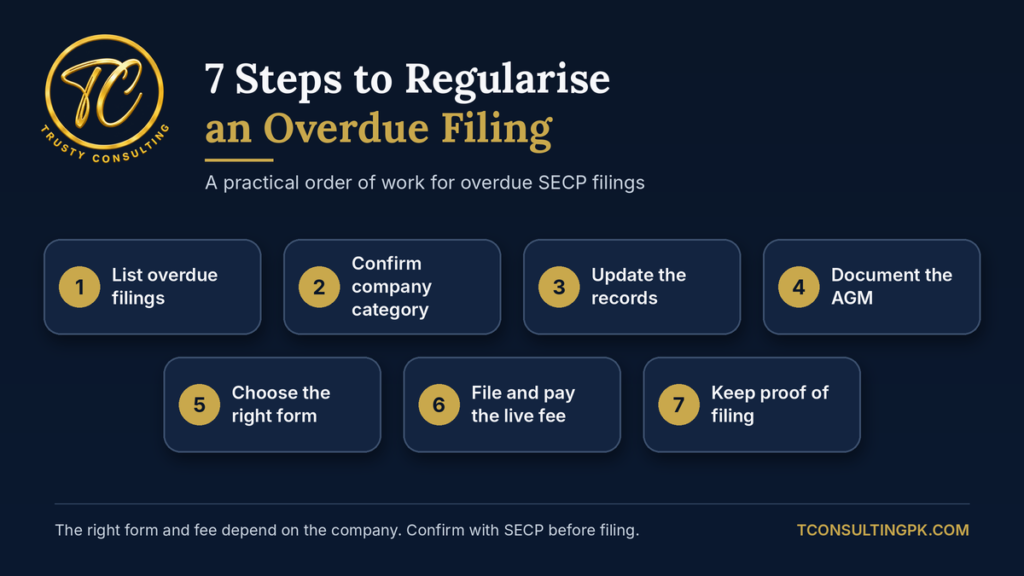
Overdue returns can still be regularised, and acting quickly limits the SECP late filing penalty that builds up with each delay band.
- List every overdue filing. Include annual returns, Form-19 and any unreported Form 9 changes, with the date each was due.
- Confirm the company category. A single member company or a small private company may have no annual return to file if nothing has changed.
- Update the records. Reconcile directors, members, share capital and the UBO register. Reliable accounting and bookkeeping support makes this far quicker.
- Hold or document the AGM. The return is prepared as at the AGM date, or the calendar year-end if no AGM was held.
- Choose the right form. Form A where particulars have changed; Form 24 where they have not and the company is eligible.
- File on eZfile and pay the live fee. The additional fee under section 468 is added for late documents, so check the amount before payment.
- Keep proof. Retain the filed return, acknowledgement and payment record in the permanent corporate file.
Practical Example: A Sialkot Sports Goods Exporter
This is a hypothetical example for illustration only, not a real client case.
A private limited company in Sialkot exports sports goods and has a 30 June year-end. Its AGM is held on 28 October, so the annual return is due on 27 November. During a shipment peak, the finance manager leaves for another job and the return is forgotten.
In January the company is asked for a corporate status check by a new buyer. The return is then 60 days late, which falls in the first band. Filing now means paying the normal fee plus an additional fee of twice the normal fee. Had the company waited until after the 90-day mark, the next band would have applied, and the buyer check would have found an unresolved default.
The lesson is simple: an SECP late filing penalty is smallest when the delay is caught early, and a compliance calendar with named owners prevents most of these cases.
How Trusty Consulting Can Support Your SECP Compliance
Trusty Consulting provides SECP compliance support in Sialkot for companies, from reviewing what is overdue to preparing and filing returns. For newly formed businesses, our company registration in Sialkot and private limited company registration guides explain the compliance duties that begin on day one.
- Review of overdue returns, Form-19 and Form 9 filings
- Preparation and review of annual return documents
- Reconciliation of directors, members and share capital records
- UBO register and declaration support
- Compliance calendar for AGM, annual return and event-based filings
- Coordination with audit and assurance services where financial statements are also pending
Together, these steps help management control SECP late filing penalty exposure before it grows.
We aim to give a clear picture of the company’s position first, so management knows what is overdue before deciding what to file.
Frequently Asked Questions About the SECP Late Filing Penalty
What is the SECP late filing penalty?
The SECP late filing penalty usually means the additional fee under section 468 of the Companies Act, 2017, charged on top of the normal fee when a document is filed after its due date. The multiple increases with the length of delay.
How much is the additional fee for late filing?
Per SECP’s FAQ, the additional fee is 2 times the prescribed filing fee within 90 days, 3 times within 180 days and 4 times within one year, with higher multiples for longer delays. The rupee amount depends on the live fee schedule, so check eZfile.
When is the annual return due?
Generally within 30 days of the AGM. If no AGM is held, the return is made up to the last day of the calendar year, and the 30-day period runs from that date.
Is a late annual return still accepted by SECP?
Yes. Section 468 allows the registrar to accept a late document on payment of the additional fee. Filing late does not remove other possible consequences of default.
Can a company be penalised separately for not filing?
Yes. Under section 130(6)(b), default in complying with the annual return requirements is an offence liable to a level 1 penalty on the standard scale. SECP may decide each case on its facts.
Do single member companies have to file an annual return every year?
Not where nothing has changed. SECP’s advisory exempts single member companies and private companies with paid-up capital of Rs 3 million or less in that situation. If particulars have changed, a Form A is required.
Is Form 29 still used for director changes?
SECP’s current statutory forms include Form 9 for particulars of directors and officers and changes in them. Older guides may still refer to Form 29, so rely on the current form.
What happens if a company misses annual returns for two years?
SECP has stated that failure to file annual returns or financial statements for two consecutive years can lead to the company being classified as inactive under section 424, following due process.
Does Form-19 also carry an SECP late filing penalty?
Form-19 is filed with the annual return, so a late return generally delays it as well. Where no annual return is required, it is due within 30 days of the calendar year-end.
Conclusion: Act Early to Keep the Cost Low
The SECP late filing penalty grows with time, not with the size of the company. Knowing each deadline, choosing the right form and filing within the first 90 days keeps the additional fee at its lowest level.
If your company has an overdue return, an unfiled Form-19 or an unreported director change, start by listing what is outstanding. Then prepare the filings in order of age. Our team can review the position with you and explain the next steps.
Disclaimer: This article is general information, not legal or tax advice. Fees, deadlines and exemptions depend on the company’s facts and the rules in force at the time of filing. Confirm the position with SECP’s current notifications or a qualified professional before acting.