
 UAE
 Saudi Arabia
 Qatar
 Oman
 Bahrain
 Kuwait
 Lebanon
 Ghana
 UK
 Ireland
 Germany
 France
 Netherlands
 Belgium
 Luxembourg
 USA
 Canada
 Australia
 New Zealand
 Singapore
 Malaysia
 Hong Kong
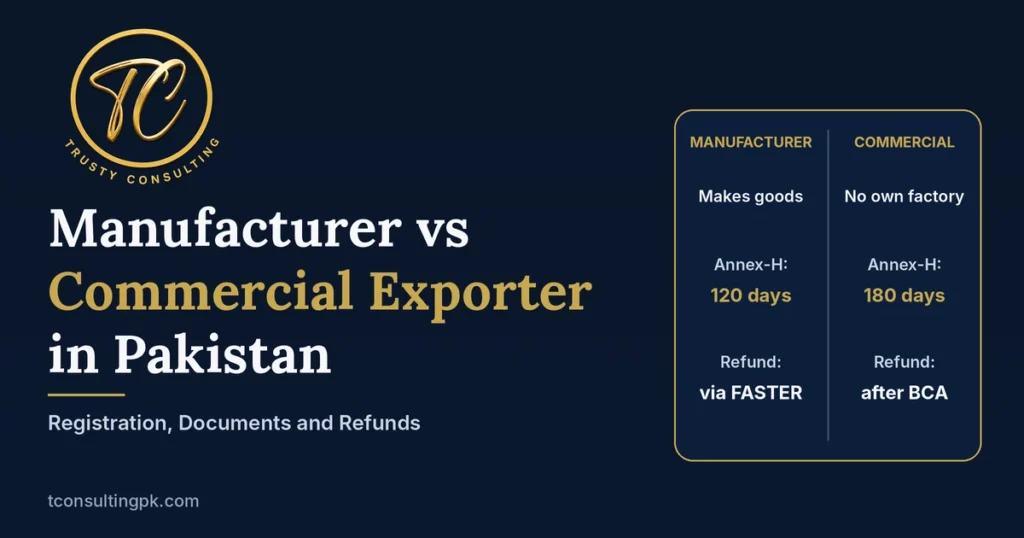
Choosing between a manufacturer vs commercial exporter in Pakistan is not just a labelling question. It decides how you register, which documents FBR expects, how your sales tax refund is processed and when the money reaches your bank account.
This guide explains the difference in plain language, based on the Sales Tax Act, 1990, the Sales Tax Rules, 2006 and the Income Tax Ordinance, 2001. It is written for exporters and finance teams, including Sialkot businesses in sports goods, surgical instruments, leather and garments.
Manufacturer vs Commercial Exporter in Pakistan: Key Facts at a Glance
| Point | Manufacturer-cum-exporter | Commercial exporter |
|---|---|---|
| Basic position | Makes the goods and exports them | Registered exporter without own manufacturing facility |
| Sales tax registration | Required for a manufacturer not running a cottage industry (s.14(1)(a)) | Required for an exporter who intends to obtain a refund (s.14(1)(d)) |
| Export supplies | Zero-rated under s.4 | Zero-rated under s.4 |
| Annex-H filing window | 120 days under Rule 28 | 180 days, counted from the later of the return or the bank credit advice (SRO 1172(I)/2020) |
| Refund payment | FASTER aims for a payment order within 72 hours | Paid only after export proceeds are realised |
| Income tax on export proceeds | 1.25% under s.154 (First Schedule, Part III, Division IV) | 1.25% under s.154; local-purchase withholding treatment differs |
[INSERT IMAGE 1 HERE — MANUFACTURER VS COMMERCIAL EXPORTER IN PAKISTAN OVERVIEW]
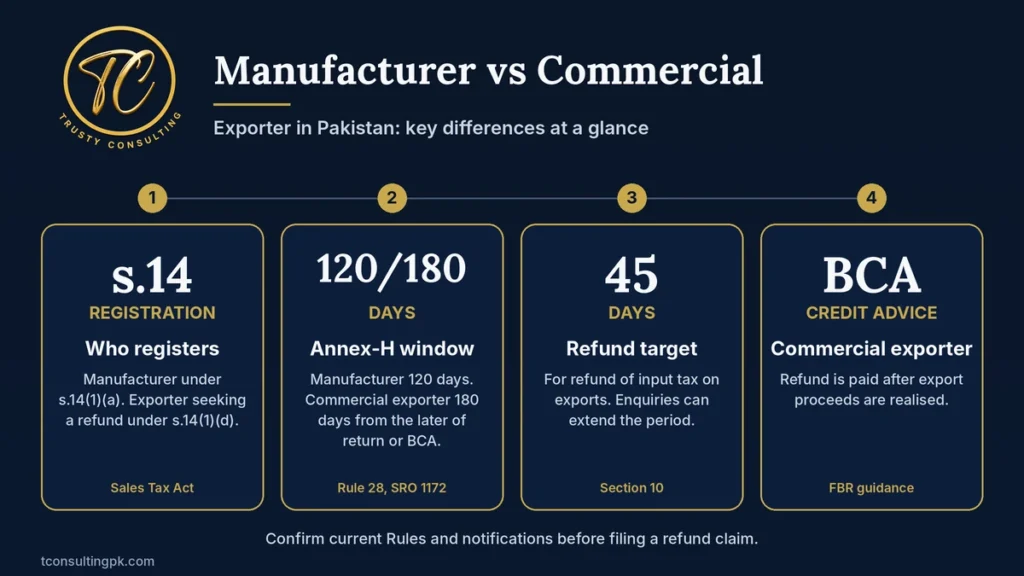
Table of Contents
Who Is a Manufacturer and Who Is a Commercial Exporter?
For manufacturer vs commercial exporter in Pakistan purposes, the two categories are defined by what the exporter actually does, not by what the business card says.
Manufacturer-cum-exporter
A manufacturer produces goods, which includes converting, assembling, mixing, cutting or preparing articles into a distinct product. If you make the goods in your own facility and export them, you are a manufacturer-cum-exporter. Think of a Sialkot sports goods factory stitching footballs or a surgical instrument unit forging and finishing forceps.
Commercial exporter
Rule 2(1)(xi) of the Sales Tax Rules, 2006 describes a commercial exporter as a person registered as an exporter who does not have his own manufacturing facility, and it covers goods exported either in the same state or after processing or manufacture. A trader who buys finished leather gloves from local makers and ships them abroad is a typical example.
Many Sialkot businesses sit between the two models, for example a unit that manufactures part of its range and outsources the rest. Mixed models should be reviewed against the facts, because the category affects every step below.
Registration Requirements: Manufacturer vs Commercial Exporter in Pakistan
Section 14 of the Sales Tax Act, 1990 requires a manufacturer who is not running a cottage industry to be registered, and it also requires an exporter who intends to obtain a sales tax refund against zero-rated supplies to be registered. Section 14(2) allows persons who are not making taxable supplies to apply for registration for imports or exports.
For a manufacturer vs commercial exporter in Pakistan, both categories need an active NTN and, for companies, the corporate registration documents. If you are still choosing a legal structure, see our guide to company registration in Sialkot before applying for sales tax registration.
| Item | Manufacturer | Commercial exporter |
|---|---|---|
| Core registrations | NTN and sales tax registration | NTN and sales tax registration |
| Evidence of business activity | Factory premises, machinery, production records | Premises, supplier contracts, buyer orders |
| Extra scrutiny | Production capacity versus declared exports | Supplier profile and traceability of purchases |
| Records to maintain (s.22) | Purchases, imports, supplies, zero-rated supplies, invoices, bank statements and inventory records | Same records, with supplier details for every purchase |
Document lists vary with the registration channel and the legal form of the business, so confirm the current requirements on FBR’s IRIS portal before you apply. If you are building an export business from scratch, our guide on starting an export business in Sialkot covers the wider setup.
Documentation for Manufacturer vs Commercial Exporter in Pakistan
In any manufacturer vs commercial exporter in Pakistan comparison, both categories must issue and hold proper tax invoices, and the rules now tie invoicing to FBR systems. Read our note on FBR digital invoicing if you are not yet integrated.
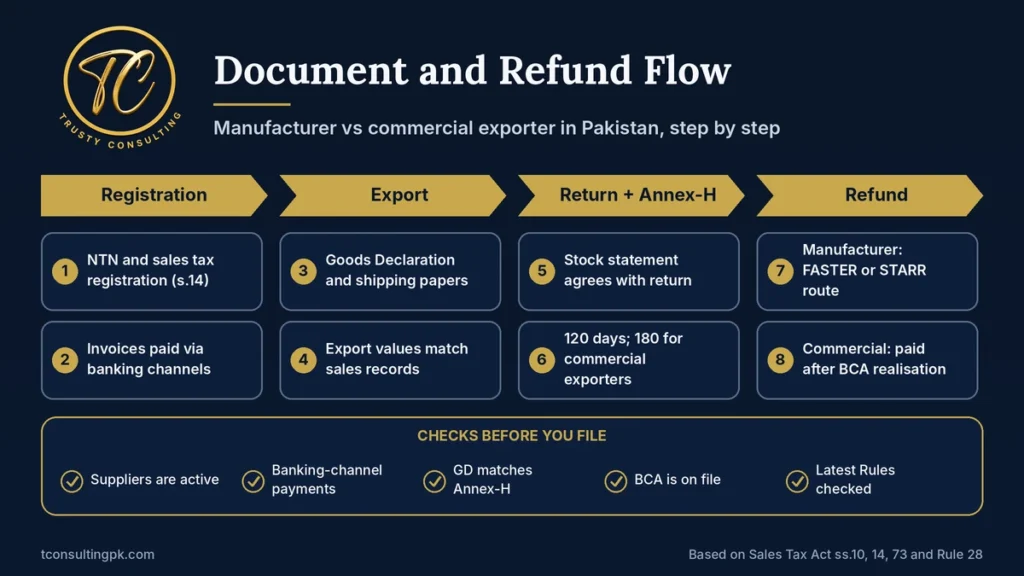
- Purchase invoices from registered suppliers, with banking-channel payment evidence (section 73).
- Export Goods Declarations and shipping documents matching your sales records.
- Bank credit advice (export proceeds realisation certificate), which is critical for commercial exporters.
- Stock records showing opening balance, purchases, consumption, exports and closing balance for Annex-H.
- Production and consumption records for manufacturers, linking raw materials to exported goods.
Refund Implications: Manufacturer vs Commercial Exporter in Pakistan
Exports are charged to sales tax at zero per cent under section 4 of the Act. Under section 10(1), excess input tax on zero-rated supplies or exports is refundable within 45 days of filing the claim, in the manner and subject to the conditions the Board notifies. The category you belong to changes the practical route.
Annex-H timing
Rule 28 allows Annex-H to be filed within 120 days. Commercial exporters often wait for the bank credit advice, which can arrive months after shipment. The FBR press release on this issue explains that the Board amended the commercial exporter time frame to match the bank credit advice cycle, through S.R.O. 1172(I)/2020 dated 4 November 2020. Press reports of the notification describe the period as 180 days from the later of the return or the credit advice date.
Payment after realisation
For commercial exporters, FBR has stated that refunds are paid after export proceeds are realised. Manufacturers whose claims are processed through the FASTER system can expect a payment order within 72 hours of the claim, provided the claim clears the system’s checks. Claims that fail the checks move to STARR for officer review, and section 10(3) allows enquiry periods of 60 days, extendable to 120 days and, with Board approval, to a maximum of nine months. Our sales tax refund guide for exporters explains these routes in more detail.
Why delays happen
In the manufacturer vs commercial exporter in Pakistan debate, the same weak points affect both groups: mismatched Annex-H figures, supplier invoices that fail validation and missing bank advices. A commercial exporter has an added exposure because its refund depends on supplier compliance and on foreign buyers paying on time.
Income Tax on Export Proceeds: Manufacturer vs Commercial Exporter in Pakistan
Section 154 of the Income Tax Ordinance, 2001 requires tax to be deducted at the time of realisation of export proceeds. The updated Ordinance copy in our reference file shows the rate in Division IV of Part III of the First Schedule as 1.25% of export proceeds, substituted by the Finance Act, 2026, and it treats the deduction as a minimum tax. Confirm the applicable tax year and rate before filing.
Illustrative example: if export proceeds are Rs 1,000,000, tax at 1.25% would be Rs 12,500. This is a hypothetical calculation to show the mechanism, not a client case.
Under the manufacturer vs commercial exporter in Pakistan framework, manufacturers also benefit from clause (45) of Part IV of the Second Schedule, which switches off section 153(1) withholding for a manufacturer-cum-exporter acting as a prescribed person, subject to two conditions: it must deduct tax on payments for goods sold in Pakistan, and it becomes liable for the tax itself if local sales exceed five per cent of export sales and tax was not deducted. Commercial exporters should not assume the same treatment applies to them.
Manufacturer vs Commercial Exporter in Pakistan: 7 Key Differences
- Production capability. A manufacturer has its own facility; a commercial exporter does not.
- Evidence. Manufacturers prove production; commercial exporters prove purchase traceability.
- Annex-H deadline. 120 days for manufacturers; 180 days for commercial exporters from the later date.
- Refund trigger. Manufacturers are paid after claim processing; commercial exporters after proceeds realisation.
- Supplier risk. Commercial exporters depend more heavily on supplier compliance.
- Withholding relief. Clause (45) relief applies to manufacturer-cum-exporters.
- Cash flow. Commercial exporters usually carry input tax longer before the refund arrives.
Common Mistakes in Manufacturer vs Commercial Exporter in Pakistan Compliance
- Registering as one category while operating as the other.
- Filing Annex-H late because the bank credit advice has not arrived.
- Buying from suppliers who are not active or whose invoices fail validation.
- Paying suppliers in cash instead of through banking channels under section 73.
- Declaring export values that do not match the Goods Declaration or bank records.
- Ignoring local sales above five per cent of exports where clause (45) conditions apply.
- Relying on an old rule book without checking later amendments and SROs.
[INSERT IMAGE 3 HERE — MANUFACTURER VS COMMERCIAL EXPORTER IN PAKISTAN CHECKLIST]
How Trusty Consulting Can Help
Trusty Consulting supports exporters in Sialkot and Karachi with registration, refund preparation and compliance. Our work includes sales tax filing and refund services in Sialkot, accounting and bookkeeping support and preparing accounts for tax purposes.
We can review your business model, explain the manufacturer vs commercial exporter in Pakistan position for your case, confirm whether you operate as a manufacturer or a commercial exporter, reconcile stock and refund figures before filing, and flag documentation gaps early. You can book a consultation to discuss your case.
Frequently Asked Questions
What is the difference between a manufacturer vs commercial exporter in Pakistan?
A manufacturer makes the goods in its own facility. A commercial exporter is a registered exporter without its own manufacturing facility. The category affects refund timing, supplier risk and some tax treatments.
Does a commercial exporter need sales tax registration?
Section 14(1)(d) requires an exporter who intends to obtain a sales tax refund against zero-rated supplies to be registered.
How long does a commercial exporter have to file Annex-H?
According to S.R.O. 1172(I)/2020 as reported by the press, 180 days, counted from the later of the return filing or the bank credit advice. Verify the current Rules before filing.
When is a commercial exporter’s refund paid?
FBR has stated that refunds to commercial exporters are paid after realisation of export proceeds.
What is the refund time limit under the Sales Tax Act?
Section 10(1) provides for refund within 45 days of filing the claim, subject to the Board’s notified conditions. Enquiries can extend the period under section 10(3).
Is export income taxed in Pakistan?
Section 154 of the Income Tax Ordinance requires deduction on realisation of export proceeds. The updated copy shows 1.25% as a minimum tax, but confirm the rate for your tax year.
Can a business be both a manufacturer and a commercial exporter?
A business may make some goods and outsource others. Each export should be assessed against the definitions, and mixed models should be reviewed professionally.
Which is better for a new exporter in Sialkot: manufacturer vs commercial exporter in Pakistan?
It depends on capital, capacity and risk appetite. Manufacturing needs a facility but gives control over inputs. Trading needs less capital but depends on supplier compliance and the credit advice cycle.
Conclusion
The manufacturer vs commercial exporter in Pakistan decision shapes your registration, documentation and refund journey. Match your category to your real operations, keep records that tie purchases, stock, exports and bank receipts together, and check current rules before every claim. If you want a second pair of eyes, speak to our team.
Disclaimer
This article is for general information only and is not legal or tax advice. Rates, deadlines and procedures change through Finance Acts and SROs. Confirm the position with FBR sources or a qualified adviser before acting.