
 UAE
 Saudi Arabia
 Qatar
 Oman
 Bahrain
 Kuwait
 Lebanon
 Ghana
 UK
 Ireland
 Germany
 France
 Netherlands
 Belgium
 Luxembourg
 USA
 Canada
 Australia
 New Zealand
 Singapore
 Malaysia
 Hong Kong
The medical allowance exemption is one of the few salary-tax reliefs that still works in an employee’s favour in Pakistan, yet many payslips in Sialkot apply it incorrectly. Under Clause (139) of Part I of the Second Schedule to the Income Tax Ordinance, 2001, medical benefits received through employment are exempt from tax in two specific situations, and the relief is lost as soon as a condition is missed.
This guide explains how the medical allowance exemption works for tax year 2027 (1 July 2026 to 30 June 2027), how to calculate it, which documents protect it and the seven mistakes that turn exempt money back into taxable salary. It is written for employees and for the HR and accounts teams who prepare their salary slips.
Table of Contents
Medical Allowance Exemption at a Glance
| Point | What the law provides |
|---|---|
| Legal basis | Clause (139), Part I, Second Schedule, Income Tax Ordinance, 2001 |
| Route 1 | Free medical treatment or hospitalisation by the employer, or reimbursement of medical or hospital charges, provided under the terms of employment. The hospital or clinic NTN must be given and the employer must certify and attest the bills. |
| Route 2 | A medical allowance up to 10% of basic salary, available only where free treatment or reimbursement is not provided under the terms of employment. |
| Not available | The former health-insurance tax credit under Section 62A, which was omitted by the Finance Act, 2022. |
| Who applies it | The employer when computing tax on salary; the employee checks it and reflects it in the annual return. |
| Biggest risk | An allowance above 10% of basic salary, or bills without hospital NTN and employer attestation, becomes taxable salary. |
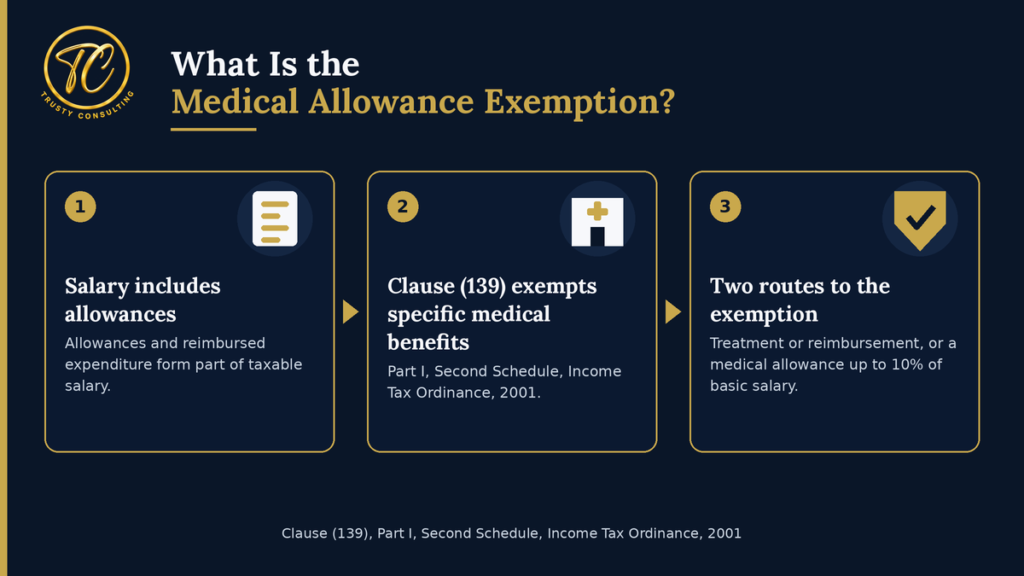
What Is the Medical Allowance Exemption Under Pakistani Tax Law?
Section 12 of the Income Tax Ordinance, 2001 treats almost everything an employer gives an employee as salary. That includes allowances such as cost of living, rent, utilities, education, entertainment or travel allowance, and any personal expenditure that the employer pays or reimburses. A medical allowance or a hospital bill paid by the employer is therefore taxable by default.
The medical allowance exemption changes that default. Clause (139) of Part I of the Second Schedule removes certain medical benefits from tax, so they do not increase the employee’s taxable salary. It is an exemption, not a tax credit: it reduces the income on which tax is calculated rather than the tax itself.
Exemption, Not a Tax Credit
Many taxpayers still search for a medical tax credit. The old credit for health-insurance investment under Section 62A was omitted by the Finance Act, 2022 and no longer exists. For salaried individuals, Clause (139) is the relief that remains, and it works only through the employment relationship.
The Second Schedule amendments reported for the Finance Act, 2026 do not list Clause (139) among the changes, and the Ordinance text reviewed for this article (amended up to 2026) retains the clause with the 10% limit. Always check for any later notification before finalising payroll.
Who Can Claim the Medical Allowance Exemption?
The medical allowance exemption is available to an employee whose employer provides a medical benefit as part of the terms of employment. It does not cover business owners, sole proprietors or partners who pay their own medical bills, because the clause is built around benefits “received by an employee”.
- Employees of private companies, factories and exporters, including staff paid a fixed medical allowance.
- Employees whose contracts or HR policy provide free treatment, hospitalisation or reimbursement of bills.
- Employees of hospitals and clinics who receive free or subsidised treatment from their own employer, which is also exempt separately under Clause (53A)(iv) of Part I of the Second Schedule.
Where the benefit is not written into the employment terms, the safest assumption is that it is taxable. The wording “in accordance with the terms of employment” is what ties the exemption to a contract or documented policy.
The Two Routes Under Clause (139)
There are two separate routes to the medical allowance exemption, and they are alternatives. The second route applies only when the first route is not offered by the employer.
| Feature | Route 1: Treatment or reimbursement | Route 2: Medical allowance |
|---|---|---|
| What the employee receives | Free treatment or hospitalisation, or reimbursement of bills the employee paid | A fixed cash medical allowance in the salary package |
| Exempt amount | The benefit or reimbursement provided under the terms of employment | Up to 10% of basic salary for the year |
| Condition on employment terms | Must be provided in accordance with the terms of employment | Applies only if free treatment or reimbursement is not provided under the terms of employment |
| Documents | Hospital or clinic NTN, and employer certification and attestation of bills | Contract and payslips showing basic salary and the allowance |
| Typical use | Corporate medical policies and hospitalisation cover | Small and mid-sized employers with a fixed monthly allowance |
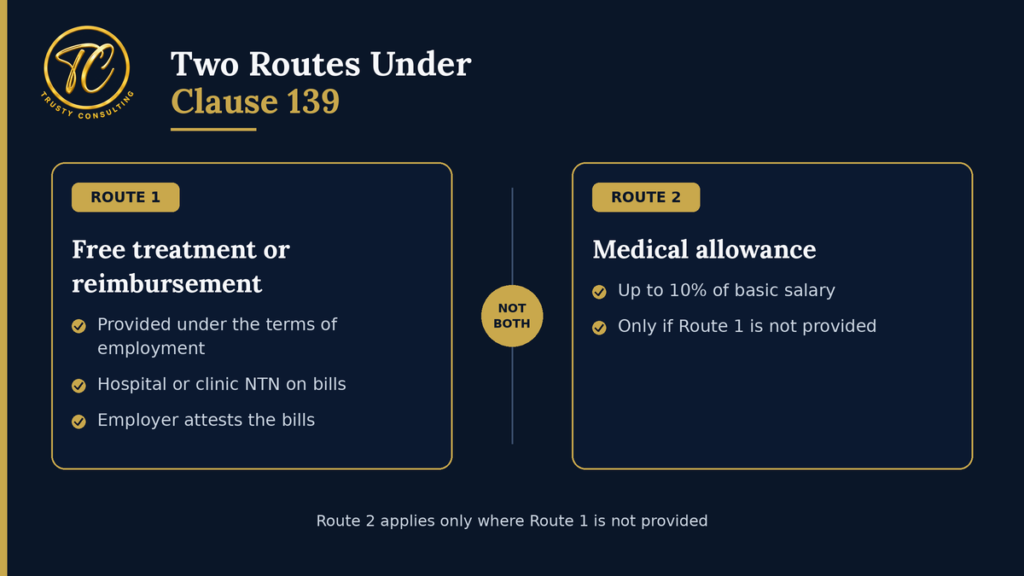
Route 1: Free Treatment or Reimbursement
If the employer provides free treatment or hospitalisation, or reimburses the charges the employee has paid, the benefit is exempt provided it follows the terms of employment. The clause adds a documentation condition: the National Tax Number of the hospital or clinic must be given, and the employer must certify and attest the medical or hospital bills.
Route 2: Fixed Medical Allowance Up to 10% of Basic Salary
Where no treatment or reimbursement facility exists, a medical allowance is exempt up to ten per cent of the employee’s basic salary. Anything above that limit stays in taxable salary. This is the route most Sialkot employees meet on their payslips, and it is where the medical allowance exemption is most often miscalculated.
How to Calculate the Medical Allowance Exemption
Use these steps each year, and again whenever the salary structure changes.
- Confirm basic salary. Take the annual basic salary from the contract and payslips. Do not use gross salary.
- Check the employment terms. If free treatment or reimbursement is provided, Route 1 applies and the cash allowance is not covered by Route 2.
- Apply the 10% limit. Multiply annual basic salary by 10% to find the maximum exempt allowance.
- Compare with the amount paid. The exempt amount is the lower of the allowance actually paid and the 10% limit.
- Add any excess to taxable salary. The part above the limit is taxed like the rest of the salary.
- Reconcile at year end. Make sure the employer’s salary certificate and your return show the same exempt and taxable figures.
If a package is stated as gross salary equal to basic salary plus a medical allowance of 10% of basic, basic salary is gross divided by 1.10. That shortcut works only when there are no other allowances in the package.
Worked Example: Hypothetical Figures
The figures below are hypothetical and are shown only to explain the method. Assume an employee with a basic salary of Rs 150,000 per month, which is Rs 1,800,000 per year, and no free treatment or reimbursement in the employment terms.
| Case | Allowance paid in the year | 10% limit | Exempt | Taxable |
|---|---|---|---|---|
| A: allowance equals the limit | Rs 180,000 | Rs 180,000 | Rs 180,000 | Nil |
| B: allowance above the limit | Rs 240,000 | Rs 180,000 | Rs 180,000 | Rs 60,000 |
| C: allowance below the limit | Rs 120,000 | Rs 180,000 | Rs 120,000 | Nil |
The tax saved equals the exempt amount multiplied by the employee’s marginal rate. As an illustration only, an exempt amount of Rs 180,000 would reduce tax by Rs 18,000 at a 10% marginal rate, Rs 36,000 at 20% and Rs 54,000 at 30%. To see your own position, use our salary tax calculator for 2026-27.
Documents That Protect the Medical Allowance Exemption
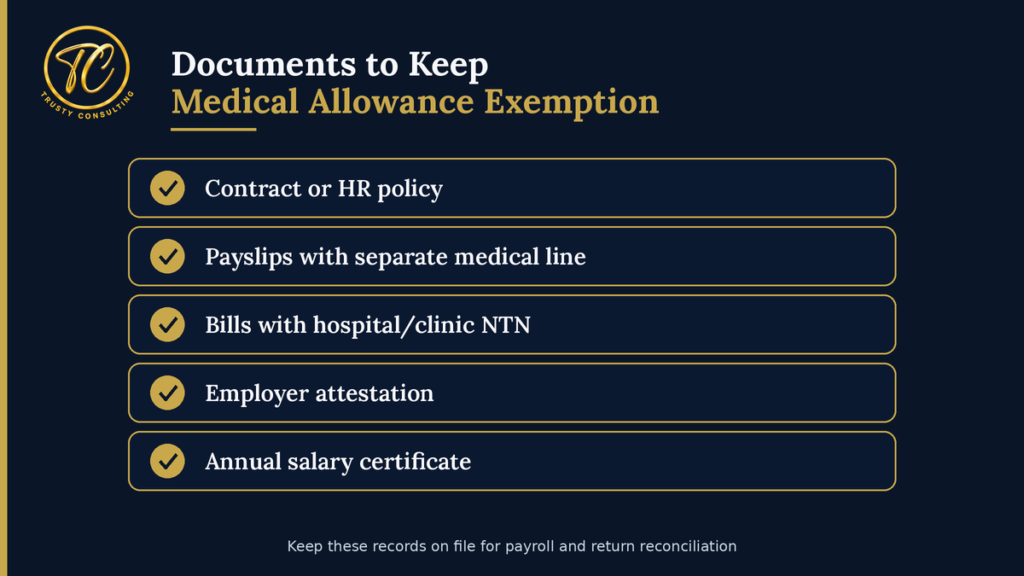
Good records decide whether an exemption survives a payroll review or an FBR query. Keep the following on file.
- Appointment letter, contract or written HR policy that states the medical benefit.
- Monthly payslips that show basic salary and the medical allowance as separate lines.
- For reimbursements: original bills, the NTN of the hospital or clinic, and the employer’s certification and attestation on each bill.
- Prescriptions or discharge summaries, kept as good practice even though the clause itself does not list them.
- The annual salary certificate issued by the employer.
[INSERT IMAGE 3 HERE — MEDICAL ALLOWANCE DOCUMENT CHECKLIST]
Practical Example: A Sialkot Exporter’s Payroll
This is a hypothetical case and does not describe a real client. A surgical-instruments exporter in Sialkot pays its supervisors a fixed medical allowance and, under the staff handbook, also reimburses hospitalisation bills. HR assumes the fixed allowance is exempt up to 10% of basic salary.
The assumption is wrong. Because the terms of employment already provide reimbursement, the medical allowance exemption for a cash allowance under Route 2 is not available, and the fixed allowance belongs in taxable salary. The reimbursed bills remain exempt only if they carry the clinic’s NTN and the employer attests them.
The fix is a documented choice. The company can keep reimbursement and stop the cash allowance, or keep the allowance and remove the reimbursement clause going forward. Which option suits the business depends on staff numbers, claim patterns and cash flow, so it should be reviewed before the next payroll cycle.
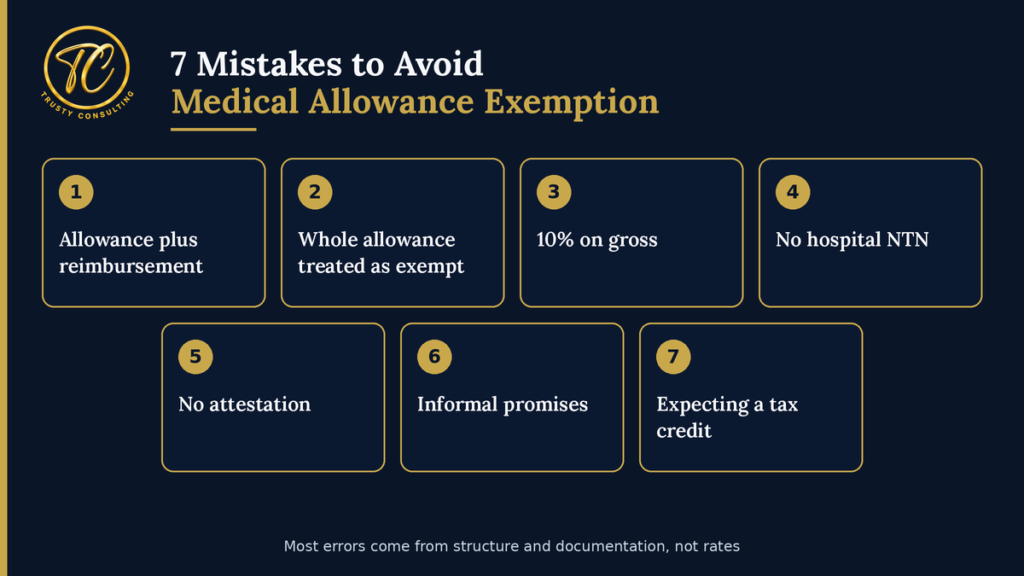
7 Common Mistakes That Cancel the Medical Allowance Exemption
- Paying both an allowance and reimbursement. Route 2 applies only where reimbursement is not provided under the terms of employment.
- Treating the whole allowance as exempt. Only the part up to 10% of basic salary is exempt; the excess is taxable.
- Calculating 10% on gross salary. The limit is based on basic salary, which is usually lower than gross.
- Accepting bills without a hospital or clinic NTN. The clause makes the NTN a condition for reimbursed bills.
- Skipping employer attestation. The employer must certify and attest the medical or hospital bills to which the clause applies.
- Relying on informal promises. Verbal reimbursement that is not in the terms of employment weakens the exemption.
- Expecting a personal tax credit. The old Section 62A credit was omitted by the Finance Act, 2022, so there is no separate credit to claim on top of Clause (139).
How Trusty Consulting Can Help
Trusty Consulting supports employees, exporters and manufacturers in Sialkot and across Pakistan with salary-related tax compliance. For the medical allowance exemption, our team can help in practical ways:
- Review a salary structure and confirm which route of Clause (139) applies.
- Prepare and file the annual return through our income tax filing service in Sialkot.
- Check withholding tax compliance on salaries and reconcile employer certificates with return figures.
- Organise documentation so that bills, policies and payslips support the exemption.
For a wider view of how salary is taxed, read our salary income tax guide for Pakistan. Government employees can also see our income tax return guide for government employees, and our Section 60D education tax relief guide covers another allowance salaried taxpayers often miss. If you want the formula behind a gross-to-basic split, our salary tax calculation example walks through it.
Frequently Asked Questions About the Medical Allowance Exemption
What is the medical allowance exemption in Pakistan?
The medical allowance exemption is a relief under Clause (139) of Part I of the Second Schedule to the Income Tax Ordinance, 2001. It exempts free medical treatment, hospitalisation or reimbursement of bills provided under the terms of employment, and a medical allowance up to 10% of basic salary where no such facility exists.
How much medical allowance is exempt from tax?
Where the employer does not provide free treatment or reimbursement, the exempt amount is the lower of the allowance actually paid and 10% of basic salary for the year. Any amount above that is taxable salary.
Is medical allowance exempt if my employer also reimburses hospital bills?
No. The 10% allowance route applies only when free treatment, hospitalisation or reimbursement is not provided under the terms of employment. If reimbursement exists, the cash allowance is not covered by that route.
Do I need receipts to claim a fixed medical allowance?
The NTN and attestation condition in Clause (139) is attached to the bills for treatment or reimbursement. A fixed allowance under the 10% route is tested against basic salary and the employment terms, so payslips and the contract are the key records.
Is the medical allowance calculated on gross or basic salary?
It is calculated on basic salary. Using gross salary overstates the exempt amount and can leave the employer or employee with a tax shortfall.
Can I claim a medical tax credit on my return?
The former health-insurance tax credit under Section 62A was omitted by the Finance Act, 2022. For salaried individuals, the relief that remains for medical benefits is the exemption in Clause (139).
Has the Finance Act, 2026 changed the medical allowance exemption?
The Second Schedule amendments reported for the Finance Act, 2026 do not list Clause (139), and the Ordinance text reviewed for this article retains the 10% limit. Check FBR notifications issued after June 2026 before finalising payroll.
Can a business owner claim the medical allowance exemption?
The clause applies to benefits received by an employee under the terms of employment. A sole proprietor or partner who pays personal medical bills is not covered by it, so the position should be reviewed with an adviser.
Conclusion: Get the Medical Allowance Exemption Right
The medical allowance exemption is valuable, but it is narrow. Decide which route your employment terms follow, keep the allowance within 10% of basic salary where Route 2 applies, and make sure every reimbursed bill carries the hospital or clinic NTN and the employer’s attestation.
A short review of the salary structure before the next payroll run is usually cheaper than correcting a year of payslips. If you are in Sialkot or elsewhere in Pakistan and want the exemption checked, contact our team.
Disclaimer: This article is for general information about the Income Tax Ordinance, 2001 and is not legal or tax advice. Tax law, notifications and FBR practice change. Please obtain professional advice on your specific facts before acting.